
Small towns need funding, partnership in the face of climate disasters
by Sydney Cromwell
The tornado siren in the town of Parrish hasn’t worked for at least three years. Probably longer.
It was broken when Bubba Cagle was elected mayor of this town of less than 1,000 people in Walker County. He was told that the needed part had been ordered. Three years later, it still hasn’t arrived.
When severe storms are heading toward Parrish, that tornado siren is usually on Cagle’s mind.
As he looks toward the future, Cagle sees threats to his town not just from tornadoes, but also from flooding, extreme heat or cold and other natural disasters. With climate change making weather patterns more intense, small towns like Parrish aren’t equipped to keep up.
RURAL RESOURCES
Local government works differently in small, rural communities.
Cagle, whose grandfather was also once the mayor of Parrish, isn’t a full-time mayor. He is also a special education teacher at Parrish Elementary/Middle School — whose mascot is the Tornadoes — and a professional wrestler.
That means a lot of the duties of his elected role happen in the evenings. Cagle said the town’s staff are hard workers who wear a lot of hats, but they still find themselves short-staffed.
That often means Cagle does tasks that aren’t strictly a mayor’s job, like writing grants or collecting someone’s trash if their regular pickup was missed.
“Whatever needs to be done,” he said.
Parrish doesn’t have a streets department, so Cagle said they rely on the county when road work is needed. The fire department is made up of 15 people, all volunteers.
“That seems like a real good number, but not everybody is available at all times,” Cagle said.
“I don’t think any community in Alabama is actually fully prepared when disaster strikes, but in rural communities, in particular, there’s far less resources and less robust infrastructure.”
Justin Vest, Hometown Organizing Project
In Camp Hill, a town of about 1,000 people in Tallapoosa County, Mayor Messiah Williams-Cole was elected at the age of 20, as he was finishing his senior year of college and preparing for law school. He said he figured it was the right time to run, since he had school and a job but no other adult responsibilities, leaving him more time to act as mayor.
A lifelong resident of Camp Hill, Williams-Cole said being mayor there involves a lot of oversight of the town’s departments and making sure everything is running smoothly.
“The main thing I do is I network and I look for grant opportunities,” he said.
Like Parrish, Camp Hill has a small municipal staff, including about 10 volunteer firefighters and five police officers.
When manpower and budgets are already at their limits under day-to-day operations in a small town, a natural disaster becomes even more devastating.
“I don’t think any community in Alabama is actually fully prepared when disaster strikes, but in rural communities, in particular, there’s far less resources and less robust infrastructure,” said Justin Vest, founder and executive director of Hometown Organizing Project, a nonprofit that focuses on solving economic and social problems in rural Alabama communities.
“We know that these storms are going to continue to happen and they’re going to be more severe,” he said.
LOOMING THREATS
Parrish was hit by the April 2011 tornado super outbreak, though not as bad as neighboring areas like Cordova, Cagle said.
There were no significant injuries in Parrish, he said, but plenty of property damage and several days without power. Residents came together to clean up, remove downed trees and bring emergency supplies to neighbors whose homes were destroyed.
“We didn’t have a big street department that we could handle it ourselves, so there were a lot of people volunteering to get things done, put tarps on roofs,” Cagle said.

Outside assistance is often in short supply for rural communities, so self-reliance is the order of the day when rebuilding after a disaster. When a tornado hit Beloit, a tiny community near Selma, earlier this year, Hometown Organizing Project arrived a couple weeks later to distribute water and supplies.
“According to residents, we were the first folks that were not in that community that came in to help,” Vest said.
Since 2011, Parrish hasn’t been hit by any tornadoes, but Cagle said he knows one could touch down again soon. Scientists have noticed that “Tornado Alley” outbreaks seem to be shifting east, away from the Plains and toward Alabama.
“It’s going to hit us sooner rather than later. There’s a lot of opportunities for storms that come through this way,” he said.
Some homes in Parrish couldn’t withstand a severe storm, such as mobile and modular homes. The town has a storm shelter that can fit around 100 to 150 people, only about a tenth of the population.
Cagle said not everyone in the area has weather radios or phone alerts. With the tornado siren still broken, there are people who won’t know when a potential tornado is coming.
“There’s still, I’m sure, a lot that don’t have access to that,” he said.
He worries that people have become complacent about the risks of severe weather as the memory of the 2011 tornadoes has receded over the past 12 years.
Occasional flooding has washed out a few streets in Parrish, which “shut down the roads for a significant amount of time,” Cagle said. Despite the danger, people continue trying to drive on the washed-out roads, even moving barriers or driving through neighboring yards to get there.
“People are just stubborn,” he said.
“It’s going to hit us sooner rather than later. There’s a lot of opportunities for storms that come through this way.”
Bubba Cagle, mayor of Parrish
The threat of severe weather for Parrish is more than just the immediate risk of injuries and property damage. The three largest businesses in the town are the local grocery store, the Jack’s and the Dollar General, Cagle said. If one of those is hit by a tornado, Parrish’s economy would suffer, perhaps for months or years.
“Bigger places, they have a bigger staff and more money. I know it would hurt them terribly, too. But a place like this, … we could easily go from doing real well to not knowing how we’re going to make it. So that’s scary when you rely on a few large businesses, their revenue, to sustain the town,” he said.
‘RAIN PTSD’
The night of March 26, 2023, started off with a rare few hours of free time for Williams-Cole. He was playing video games with a friend when he heard a storm rolling in at around 2:30 a.m.
He wasn’t particularly worried about the storm’s severity, at first.
“I’ve never lived through a tornado. Tornadoes have always gone around Camp Hill,” Williams-Cole said. “… We kind of had this false sense of security that nothing bad would ever happen because we’d been so lucky in years previous.”
This storm didn’t bring a tornado, either. Instead, it dropped softball-sized hail on the town.
“It lasted maybe seven, eight minutes, but it seemed like forever,” Williams-Cole said.
In that time, around three quarters of the homes and nearly every car in Camp Hill were damaged, he said. About 20 to 30% of the cars were totaled.
The storm also flooded some areas of the town, another first in Williams-Cole’s experience.
“It’s called Camp Hill because we’re literally on top of a giant hill. … That’s the only time in my life. We’ve never had flooding,” he said.
After the hail stopped, Williams-Cole first went next door to check on his mother, who had some broken windows. He said it was fortunate the hail storm came at night, since no one was outside to potentially be struck.
The next day, cleanup work began both for families and for the town’s employees. All but one of the police cruisers were damaged, so the officers drove ATVs and trucks with busted windows, Williams-Cole said.
“Lots of folks had literal holes punched into their roofs,” Vest said. Hometown Organizing Project spent a week in Camp Hill doing a damage survey of 500 homes and helping clean up.
“Climate change has always been something I never really thought about, not because I don’t believe in it but because there’s a million other things to think about. Now, I think about it often.”
Messiah Williams-Cole, mayor of Camp Hill
The cleanup gave Williams-Cole a taste of the limitations of being mayor. The Alabama Ethics Commission has restrictions on how local governments can provide resources or aid to individual people. It’s meant to prevent corruption and misuse of public funds, but it also meant the young mayor was limited in how he could help his neighbors.
“We are prohibited from working 30 feet from the middle of the road,” he said. “… We couldn’t help people clean up in their yards.”
Frustrated, Williams-Cole said he finally decided to report himself to the Ethics Commission and start picking up limbs anyway.
“Morale is bad in town. We need to go and clean up their yards,” he said. “… I have to do this. I have to.”
He did not receive a fine.
Since March, Williams-Cole has had what he calls “rain PTSD,” worrying that every rainstorm could bring another wave of hail and damage to the town.
“It’s something we have to take with us, it’s another uncertainty,” he said. “… Climate change has always been something I never really thought about, not because I don’t believe in it but because there’s a million other things to think about. Now, I think about it often.”
‘THEY WANT A SEXY DISASTER’
The damage from a hail storm unfolds less dramatically than that of other severe weather, like hurricanes or tornadoes.
There was the immediate damage: broken windows, totaled cars, hailstones that came through roofs and garage doors. Then, for people whose cars were no longer drivable, it became hard to get to work or to the grocery store.
“It had huge ripple effects,” Vest said. “… It created all these issues overnight.”
For families who didn’t have home insurance or couldn’t afford immediate repairs, the hail damage became an entry point for water leaks and mold, William-Cole said, with potential long-term structural and health problems.
“People’s health isn’t static. If a problem happens, it’s not going to get better if you let it sit. It’s going to get worse,” he said.
If the money was available, Williams-Cole estimates that Camp Hill could fully repair its damage within a year or two. As it stands, though, “some homes, I don’t ever see being the same again,” he said.
In trying to navigate the situation and find financial assistance for people to repair their homes and cars, Williams-Cole ran into a new frustration, this time on the federal level rather than the state.
After a disaster, the Federal Emergency Management Agency (FEMA) offers three kinds of financial assistance: individual, for people and households; public, for local governments, certain nonprofits and similar entities; and hazard mitigation, for preventing future property loss.
Individual assistance can be used to repair homes or other property damage and cover losses that insurance doesn’t. Public assistance can help cover the money that a municipality or nonprofit spends on emergency rescue, debris removal or repairing public buildings or infrastructure.

There are also programs like the U.S. Department of Agriculture (USDA) rural development disaster assistance program and Small Business Administration (SBA) low-interest loans that can offer financial aid after a disaster. In some cases FEMA will also grant funding for other needs like temporary housing, medical care, therapy, unemployment assistance and legal services.
The type of funding available, and the dollar amount, is different for each disaster. FEMA calculates the assistance it will offer based on six factors, the first two being the most important:
- The available resources and financial capacity of the state where the disaster occurred
- The amount of uninsured loss of homes and personal property
- The amount of injuries and fatalities caused by the disaster
- The demographics of the community, such as age, income level or disability
- The impact to community infrastructure, such as emergency responders, medical care, water treatment or schools
- The amount of unemployment caused by the disaster
Determining assistance based on these factors isn’t a simple math equation, and there aren’t different criteria for areas with different population sizes.
According to FEMA, the agency has approved around 90% of disaster declaration requests where the cost of the assistance needed was more than $7.5 million, 42% of requests where assistance cost between $1.5 million and $7.5 million and only 6% of requests for assistance costing less than $1.5 million.
Camp Hill qualified for public assistance, but not individual assistance, after the hail storm. Williams-Cole said he feels like it’s harder for rural, low-income communities to reach the property loss threshold that FEMA sets.
“If you have a community that has lower home prices, it’s just not going to add up, even if it’s the same amount of properties damaged,” he said.
The hail damage being less immediately destructive than, say, a tornado or straight-line winds also worked against Camp Hill, he said.
“They want a sexy disaster. And what I mean by that is, you go [look] when a tornado hits, a house that was there yesterday isn’t there today,” Williams-Cole said.
Williams-Cole said he’s glad the town received FEMA public assistance to repair community infrastructure, but the municipal government already had good insurance and won’t struggle to rebuild the way many homeowners will.
“My concern lies with the average citizen,” he said.
Even when individual assistance is made available, there are still hurdles to clear to receive it, Vest said. Different assistance programs have their own criteria for eligibility or may require individuals to apply for FEMA aid first.
“It gets hard to navigate,” Vest said.
A few types of FEMA individual assistance require homeowners to apply for an SBA loan first, then re-apply to FEMA if they’re turned down or aren’t awarded enough to cover their damage.
“It’s a lot of red tape and a lot of documentation that you have to go through,” Williams-Cole said.
Families often have to apply to these programs while they still don’t have reliable power, internet access or a car, and are dealing with the immediate impacts of a disaster.
“That creates a barrier,” Vest said.
NEIGHBORLY SOLUTIONS
Cagle said he first learned about Camp Hill’s hail storm experience through meeting Vest and the Hometown Organizing Project. He said it’s “definitely scary” to imagine Parrish in a similar situation without the resources it needs.
“There’s a lot of things you just don’t think about sometimes until it happens, or it happens to somebody else,” Cagle said.
Vest and the staff at Hometown Organizing Project have seen this same scenario play out in several small Alabama communities.
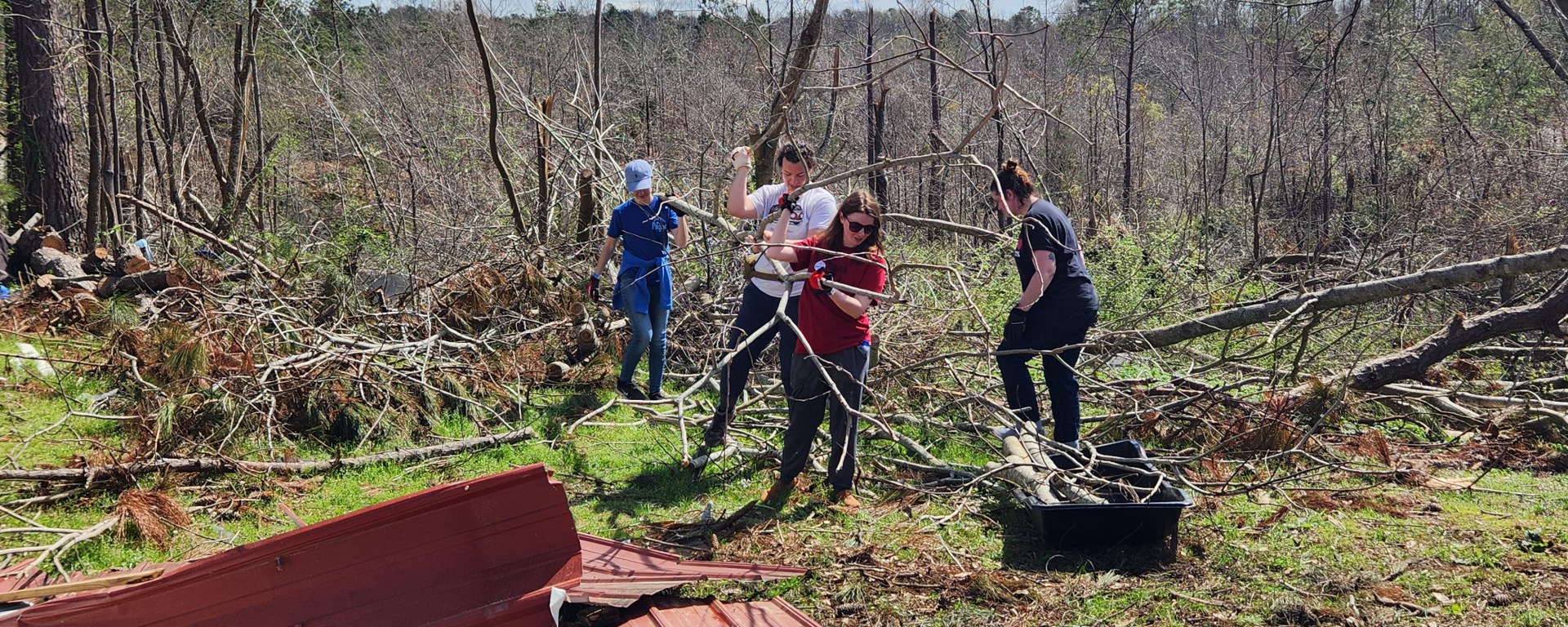
In the 150-person town of Equality, for instance, the ongoing recovery efforts after an EF-3 tornado in January are being led by a retired teacher because there were no civic groups or officials to take charge, Vest said.
“A lot of times, these disasters in rural communities fly under the radar,” Vest said.
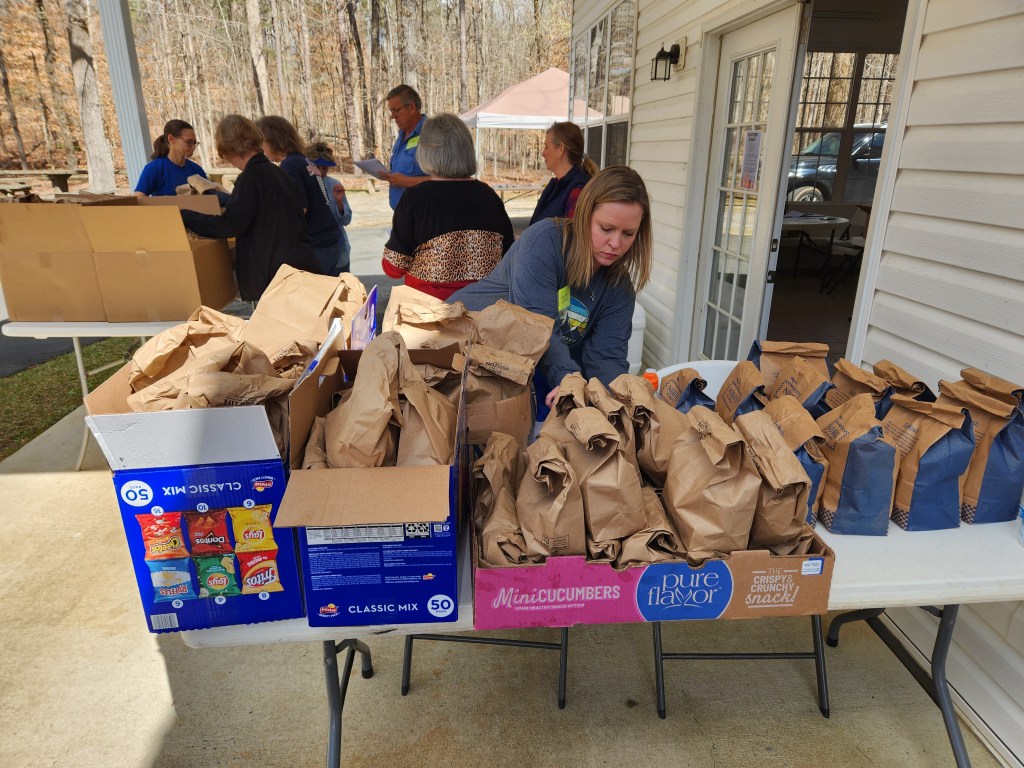
Hometown Organizing Project’s first disaster recovery experience was in Beauregard, when a tornado touched down in March 2019 and killed 23 people. The organization helped with cleanup, fundraising and connecting people with resources.
“It was the first time that we were addressing it, in the sense of climate change showing up in one of our communities and showing up in a really tangible way,” Vest said.
These communities are eager to be better prepared and have solutions when these disasters strike, he said — they just don’t know how to get there.
Williams-Cole believes there need to be changes to state and federal disaster relief, or else “it’s going to be the death of a lot of small towns.” That kind of change, however, would take a long time to bring about.
Climate activists nationally also tend to be focused on “policy solutions that will start to have an impact maybe 10 years down the road,” Vest said. He added that many of those solutions are put toward “states that, let’s be real, are more politically significant to the folks in power.”
But small communities in Alabama have an immediate need for better disaster preparedness and can’t wait for long-term solutions.
“The climate crisis is already here,” Vest said. “… In the South, we’re on the front lines of the climate crisis.”
The short-term answers will come on the local level.
Last year, Hometown Organizing Project began formulating the idea of a climate canvass and protection program, to look at disaster and extreme weather preparedness in small communities. As they began building relationships and talking with communities about participating, climate and sustainability coordinator Kenya Goodson said they have gotten pretty much universal positive feedback.
“People are really willing for Hometown to come in and assist,” Goodson said. “… To me, that really speaks to people wanting to get help, wanting to get assistance for their communities.”
The climate canvass will start with conversations about past natural disasters that people have experienced and about gaps in their emergency planning. Then the project will move on to education and training to create local response teams and disaster plans.
“[We] take it on the chin and then we fight back, but we never train for the fight.”
Messiah Williams-Cole, mayor of Camp Hill
Hometown Organizing Project, along with its partners Hometown Action and Political Healers Project, selected 10 towns to participate: Cherokee and Leighton in Colbert County; Equality and Rockford in Coosa County; Beloit and Selmont/West Selmont in Dallas County; Camp Hill and Reeltown in Tallapoosa County; and Dora/Yerkwood and Parrish in Walker County.
The communities were chosen either because they had a recent natural disaster or are frequently in the pathway of storms. They are also meant to represent the variety of rural communities in Alabama.
Vest said people seem to be excited about “this notion of having local people come together so they’re more prepared when the next disaster hits.”
Cagle said he hopes participating can help Parrish break through some of its complacency around storms. He also hopes the climate protection program can help Parrish find funding for projects it needs, like a new storm shelter, drainage fixes for the roads and resources to prepare citizens for extreme heat or cold.
Williams-Cole said it can be hard for a community like Camp Hill to plan ahead for something like a natural disaster, both because they lack the expertise and because there are always other pressing concerns in daily life.
“A lot of times, when we are thrown things in Camp Hill, we react to them, we respond to them, we do what needs to be done and move on,” he said. “… [We] take it on the chin and then we fight back, but we never train for the fight.”
Williams-Cole said this is an area where he and the local government need to step up and lead the way.
“We have to really prepare for ourselves and everyone else, so we have a response and they have access to that response,” he said.
That gap between wanting a plan and having a plan is what Hometown Organizing Project wants to bridge with the canvass.
CLIMATE CANVASS
Hometown Organizing Project began canvassing its 10 towns through door-to-door visits and phone surveys in September, and that work will continue through December.
The goal is to have conversations with at least 1,000 people. Vest said as they talk with people about their past storm experiences and future preparedness, he expects to hear about those under-the-radar storms that only affected small areas, but were devastating nonetheless to the communities living there.
“We’re looking to uplift the voices of the individuals being impacted by these disasters,” said Bianca Santini-Dumas, Hometown Organizing Project’s communications specialist.
In places where there just weren’t enough dollars available to rebuild, Vest said he expects to see unmet needs that range from fixing mold to families who have been “effectively homeless” since their homes were destroyed.
“No one has to agree that climate change is real. … We’re just inviting folks to step up and take a role in protecting their community. They can call it what they want.”
Justin Vest, Hometown Organizing Project
There’s also an emotional component to living through a natural disaster, like the “rain PTSD” that Williams-Cole experiences. After the door-to-door and phone surveys are complete, the next stage of the climate canvass will be a “road tour” to encourage communities to gather and talk through the stress, loss and grief they have experienced.
Political Healers Project, a Montgomery-based organization, is participating in the canvass to help address this aspect of rebuilding a community.
“I think we’re going to hear a lot about unresolved trauma. Whether people realize that’s what it is,” Vest said.
The next phase will be a 12-week training course for community leaders to learn about emergency preparedness, response and recovery, as well as how to build their local climate protection teams.
The final phase will be recruiting and forming these protection teams, with the goal to have them established in the next two to three years.
Based on a test canvass that Hometown Organizing Project did in Tuscaloosa last year, Goodson said there’s probably education about climate change that is still needed in order for communities to prepare for it.
“There are some people that are resistant to climate [change], they don’t believe in that, … but most people weren’t familiar with the term ‘climate change’, and that was surprising,” Goodson said.
But though “climate” is in the name, Vest said the focus of the climate canvass is on community safety, not politics.
“No one has to agree that climate change is real,” he said. “… We’re just inviting folks to step up and take a role in protecting their community. They can call it what they want.”
Main article image of storm cleanup in Equality, Alabama, by Mich Lovegood, courtesy of Hometown Organizing Project.
 Southern Science
4 thoughts on “Come together”