
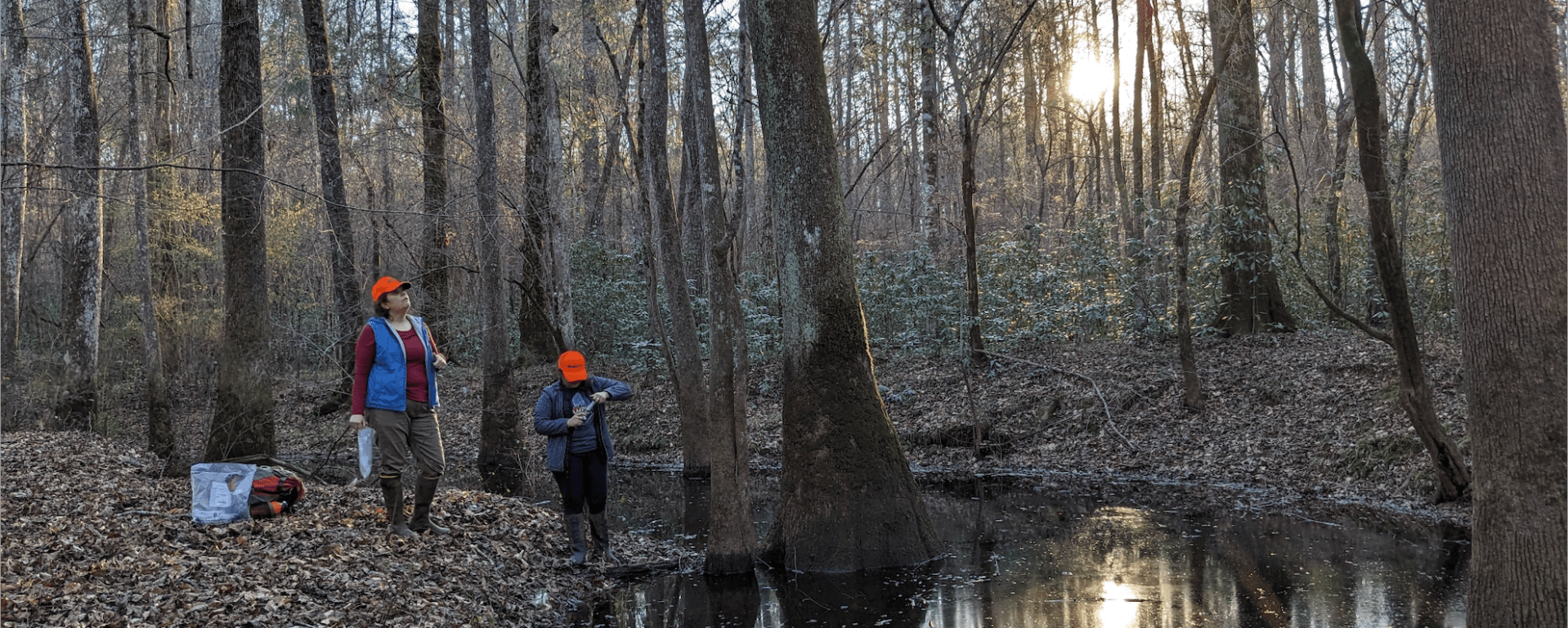
Researchers study relationships between wetlands, microbes, greenhouse gasses
by Sydney Cromwell
Every ecosystem has its own life cycle, its own rhythms. Few, though, are as changeable as the small wetlands scattered across the Tanglewood Biological Station, south of Tuscaloosa.
In dry seasons, these tiny wetlands — some less than an acre in size — seem to disappear entirely, their waters absorbed into the ground or carried away by nearby streams. But when it rains, a whole microbial community blooms into life as the soil is submerged again.
According to researchers at Tanglewood, there’s a lot that still isn’t understood about this life cycle — and those unanswered questions have major implications for everything from agriculture and water quality to climate change.
WATER, WATER EVERYWHERE
About 10% of the state of Alabama is covered by wetlands, according to the U.S. Fish and Wildlife Service. The Mobile-Tensaw River Delta, for instance, covers 100,000 acres.
But much of that 10% is made up of small wetlands (defined as an area less than 5 acres) that are dotted around the state.
“Our wetlands are both numerous and they’re everywhere, and it’s awesome,” said Nate Jones, a professor of ecohydrology at the University of Alabama. “… These wetlands have more surface area than larger water bodies because they’re so small and distributed, and that’s the power of these things, I think.”
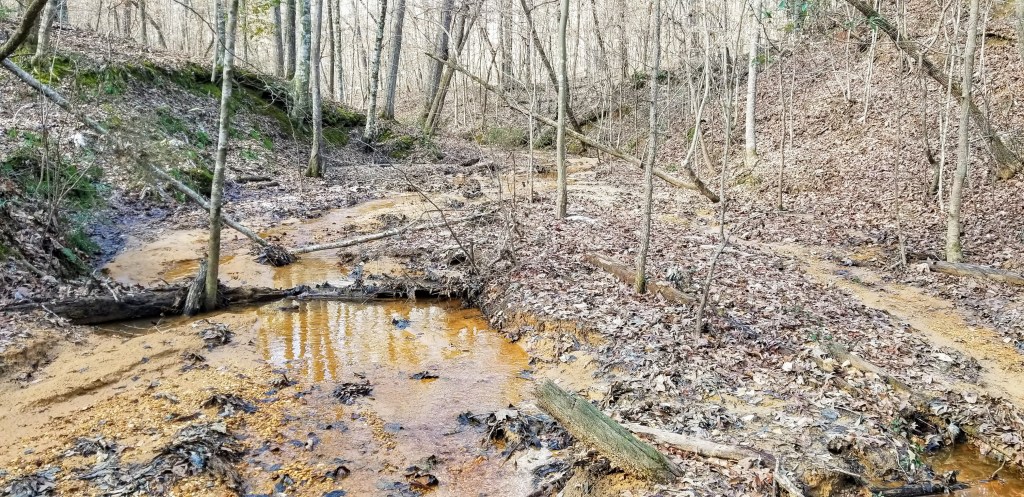
Small wetlands are “beautiful, special places,” Jones said. They often form at the heads of streams, where rainwater or runoff collects. They can also be formed by groundwater welling up through the soil or a stream that overflows its banks in heavy rain.
Sometimes small wetlands are created as a byproduct of land development, such as leveling ground or paving a parking lot, that changes where and how the water flows.
Jones said the farming of cotton and lumber in the state’s history led to a lot of soil erosion, forming gullies that would eventually become small wetlands.
“Maybe we should not have been growing cotton in some parts of Alabama because we lost a lot of soils during that time” due to bad agricultural practices, he said. “… The bad is that we’ve lost a lot of our topsoil, but in the process we’ve created these wetlands that are biodiversity hotspots.”
Whether the wetland is natural or manmade, the water that flows into it often carries carbon, nitrogen, phosphorus and other chemicals picked up along the way. By trapping the water flow, wetlands allow time for these chemicals to be consumed by microscopic creatures or deposited into the soil, rather than being carried downstream to pollute larger waterways, Jones said.
The constant change that’s happening in small wetlands — wetting and drying, new pollutants and nutrients flowing in and out — makes them “really dynamic environments,” said Corianne Tatariw, an assistant professor of environmental sciences at Rowan University who works with Jones at Tanglewood.
‘THERE’S A MICROBE FOR THAT’
To see that dynamic environment in action, you have to zoom in. Way in.
Life as a wetland microbe doesn’t look much like life that most of us are used to seeing.
“Microbes are operating on spatial and temporal scales that are vastly smaller than what we can relate to,” Tatariw said.
Some microbes consume nitrates from plant fertilizers, while others might eat carbon or phosphorus, she said. Some rapidly digest simple molecules, while others eat complex materials that take more time to break down.
“If there is anything in the world that needs to be degraded or utilized, there’s a microbe for that,” Tatariw said.
The fresh water that brings these chemicals into the wetlands also supplies the oxygen many microbes need to breathe, Jones said. The microbes immediately respond, eating and multiplying.
As the oxygen levels in the wet soil deplete, other microbes that depend on chemicals like nitrogen or iron will start to boom instead, Jones said.
When their ideal environment disappears, however, the microbes don’t disappear along with it.
Some species can survive in tiny amounts of water trapped in the pores between soil, Tatariw said, even as the rest of the wetland dries up. Others can go dormant or create spores that will wait until the right conditions return to create a new generation.
“Microbes are tough little suckers,” Tatariw said. “… Microbes have strategies that allow them to survive in not-optimal conditions.”
When the small wetlands go dry, that’s when “a lot of this magic happens” from a chemical perspective, Jones said. Sediments and dead plant matter continue to collect in the wetlands, slowly decaying and creating what Jones described as “high-quality” carbon.
Once rain or groundwater floods the wetland, “the microbes get this burst of nutrients and carbon and energy” to start the process again, Jones said.
While the wetlands themselves may be small, their impact isn’t. Wetlands store a massive amount of the world’s carbon in their plant life and soil.
“Our wetlands are both numerous and they’re everywhere, and it’s awesome.”
Nate Jones, University of Alabama
That carbon storage is beneficial, but it comes at a cost. As they digest certain chemicals, these microbes can release methane and nitrous oxide. Whether the methane emissions outweigh the carbon storage depends on the wetland.
“These wetlands are really, really good at removing pollutants such as nitrate, but they also produce a lot of greenhouse gasses,” Jones said.
Dan Barrie, a program manager at the NOAA Climate Program Office, said wetlands worldwide account for about 20% of the methane that moves between land and atmosphere annually.
KNOWLEDGE GAPS
At the 567-acre Tanglewood station, Jones’s research focuses on how carbon and water move through small wetlands and how the wet-dry cycle affects carbon quality and chemical processes.
Tatariw’s related research is on how microbes remove nitrogen from the water (a process called denitrification) and what chemicals are being carried from the wetlands into streams and rivers, particularly at different water levels.
Jones said small wetlands don’t get as much research attention as larger ones, so less is known about how they work. Since they periodically dry up, Tatariw said, it’s hard to even predict when the small wetlands will appear.
“It turns out there are knowledge gaps for reasons, and it’s because they’re hard to fill,” she said.
Their current research project, which started its second year in October, is funded in part by a grant of nearly $1 million from the U.S. Department of Energy’s Environmental System Science program.
In part, the research at Tanglewood is meant to create the “baseline understanding” of small wetlands that is currently missing, Tatariw said.
The field work so far, she said, has mainly involved “digging a lot of holes in the woods.”
In the first year, the Tanglewood team installed around 50 shallow groundwater wells to track the wet-dry cycle, “how much water is stored in the wetlands and then how it’s moving to and from the wetlands,” Jones said.

This year’s work will include installing equipment to measure carbon and nitrogen levels in the water flowing out from the wetlands, Jones said. The team will also begin using autosamplers to collect rainwater during storms, he said.
In the lab, researchers are studying denitrification and other chemical processes with soil samples taken from Tanglewood’s wetlands, Jones said.
The third year of the project will include closer study of carbon samples and microbe interactions, Jones said. This type of research is “special,” he added, because it’s rare to get to look at an ecosystem from so many different levels.
“It’s one of the most data-rich projects I’ve ever been a part of,” he said.
The scale of the project also requires a big team.
While she used to be a postdoctoral researcher at Alabama, Tatariw’s role since becoming a professor at Rowan University has included a lot of troubleshooting by phone. She also works on optimizing lab experiments, then returns to Tanglewood during the summer to conduct more lab work.
Working alongside Jones and Tatariw is Behzad Mortazavi, who was formerly part of the UA biological sciences department but is now at Syracuse University. Tatariw said their student researchers — postdoc Ashleigh Kirker, doctoral student Lidia Molina Serpas, graduate student Jasmine Morejon and undergraduate Elaine Rice — have also been indispensable.
“It’s one of the most data-rich projects I’ve ever been a part of.”
Nate Jones, University of Alabama
The UA team has another important partner: the Pacific Northwest National Laboratory, located in Washington. Jones said the PNNL will take the data collected at Tanglewood and attempt to create computer models that can depict small wetlands and predict how things like flooding, climate change and land development will affect them and their chemical processes.
“They’re providing a ton of support,” said Jones.
Tatariw said wetlands don’t seem to have dependable patterns in their water levels, plant growth, microbial activity and other characteristics.
“Wetlands that are the same type are behaving the same way, but they aren’t being consistent about it,” she said.
She hopes the model might eventually help explain these varying patterns.
“It’s really exciting because it helps us take this up another level,” Tatariw said.
MODEL BEHAVIOR
Most small wetlands can’t be studied with the same level of detail as the Tanglewood wetlands.
“It’s really difficult to characterize fluctuations in the field because you can’t measure everything, everywhere, all the time,” Jones said.
If the PNNL model is successful, it can be applied to similar ecosystems across the country and give a reliable picture of how those ecosystems and their life cycles change in different scenarios.
“What’s difficult, and what we really are striving to do with this project, is take these small-scale processes and understand them across the larger landscape,” Jones said.
Modeling the carbon and nitrogen cycles of small wetlands could add new elements to the data that climate scientists use to forecast possible future scenarios. Right now, small wetlands — as the name suggests — are simply too small to show up in global climate modeling.
Read more from Southern Science about climate modeling.
Most current climate models break up the landscape into squares that are 100 kilometers (about 62 miles) per side, according to Adam Schlosser, the deputy director of MIT’s Joint Program on Science and Policy of Global Change.
Within those squares, Schlosser said, scientists estimate the percentages of different land uses, creating a “mosaic” that simulates the real world but isn’t an exact match.
Some models can be scaled down to look at a more specific area, Schlosser said, but there are limits in both data and computing power that prevent climate scientists from breaking the global mosaic down into even smaller pieces.
“Even with those really detailed models, again that are focused on a very small region, the rub is that all of those have boundaries. You’re only modeling a certain size domain, and that domain has edges to it,” Schlosser said.
And a 1-acre wetland that appears and disappears depending on the rain? That’s hard to model with confidence, he said.
“There’s really no clear answer that’s coming out right now” at that level of detail, Schlosser said.
Climate models have steadily had new measurements and data sources added to them since the earliest models of the 1970s. Jones believes a working model of small wetlands would be yet another step forward for climate modelers to improve their accuracy.
Barrie, on the other hand, is more measured. While he said that wetlands are important in predicting future carbon storage and emissions, they are only one factor out of many that are observed and included in modeling.
“The degree of impact on the net performance of climate models if wetlands were completely left out would not be large,” Barrie said.
STRESSED SWAMPS
As wetlands contribute to climate change, they also continue to be changed by it.
More intense flooding and severe storms can wash out or overwhelm a wetland, causing chemicals to keep flowing downstream and worsen water quality. Droughts can cause the dried-out soil to release formerly trapped carbon dioxide into the air.
Tatariw said accurate modeling can help predict how small wetlands will bear those pressures, as well as what conditions might change a wetland so much that it’s “operating fundamentally differently than it was before.”
“Just because you can’t drive a canoe into our little mud puddle in the woods doesn’t mean it isn’t worthy of protection.”
Corianne Tatariw, Rowan University
When it comes to wetlands’ long-term survival, “at best, climate is about half the problem,” Schlosser said. Local land and water management are also putting wetlands under a lot of stress.
Globally, more than a third of wetlands have been lost since the 1970s, according to the U.N. Framework Convention on Climate Change. Many have been drained or filled in to repurpose the land for new development.
Other wetlands still exist, but the runoff from neighboring roads, parking lots and farms have permanently changed the wetlands’ life cycle and what species can thrive there. Higher amounts of nitrogen in the water, such as from agricultural chemicals, appear to harm wetlands’ ability to store carbon.
“As we continue to develop and change our landscape in this region, it’s really important to understand what effect it’s having on the wetlands,” Jones said.
In August, many wetlands lost their federal protection after a Supreme Court decision forced the EPA to narrow its standards for waterways regulated by the Clean Water Act. Protecting these wetlands now falls to individual states, and Jones and Tatariw both said that leaves Alabama’s wetlands vulnerable.
“I think we’re going to see a lot of these wetlands lost, … and I do think that’s a shame because of the ecosystem services they provide,” Jones said.
As for the future of Alabama’s small wetlands in the face of these threats, Jones said no one has the answers about what will happen and what choices will be made. But their health will have ripple effects downstream and potentially globally.
“Just because you can’t drive a canoe into our little mud puddle in the woods doesn’t mean it isn’t worthy of protection,” Tatariw said.
Main article image of researchers at Tanglewood Biological Station, courtesy of Nate Jones.
 Southern Science
2 thoughts on “An entire world in a puddle”