
Religious climate activists focus on energy, justice in the Southeast
by Sydney Cromwell
Climate anxiety. Crisis fatigue.
Whatever you call it, spend enough time thinking and reading about the realities — and the immediacy — of climate change, and it’s easy to let it get you down.
For Rhoda Vanderhart, a Mobile resident and one of the founders of Gulf Coast Creation Care, that moment came when she read Jim Antal’s book “Climate Church, Climate World” with her church group in 2019. The book made her realize how close the world is to reaching tipping points that will permanently alter human life on earth.
“It threw me into such a depression,” she said.
For Stephen Guesman, a Blount County resident who says he has been an environmentalist since the first Earth Day in 1970, his dismay came from seeing how often his friends’ environmentalism stopped at driving a gas-guzzling SUV to the recycling center.
“That’s not even going to leave skid marks on the edge of the cliff. We’ve got to have much more radical change than that,” Guesman said.
When Vanderhart is among other environmental activists, she said the despair can almost be off-putting.
“All of these groups, when I’m in their spaces, it’s emotionally exhausting,” she said. “… It’s just daunting, and it’s a lot of feeling of hopelessness and despair because as we all know, what one person does doesn’t really affect anything. We have to do it together.”
The antidote to that fatigue, in Vanderhart’s case, was her religious belief.
“I think that the climate movement, the activists that are trying to save the world and make a change, the piece that they’re missing is the faith piece,” she said. “… That all is something that we have pushed aside in the science and technology age, and something that I think we need to reclaim.”
Through groups like Interfaith Power & Light and Gulf Coast Creation Care, Vanderhart, Guesman and others in Alabama are trying to bring together their faith with activism for the climate and for the most vulnerable communities in the state.
“For me, that is the piece that makes a whole,” Vanderhart said.
SEPARATION OF CHURCH AND CLIMATE
Churches and climate activists aren’t often paired together. According to Pew research in 2022, highly religious Americans are the least likely group to consider climate change to be a serious problem or to believe it is caused by human actions.
“There’s a lot of toxic theology here in the Bible Belt that’s gotten us into our current situation,” said Kyle Crider, the program and policy director of Interfaith Power & Light and the People’s Justice Council.
“Misinformation kills and in the case of climate change is hamstringing us, because if you can’t talk about it, you might not be doing the things you need to do to fix it.”
Kyle Crider, Interfaith Power & Light
Climate change is “the term that shall not be named” for many in Alabama, Crider said, which makes it harder to address.
“From a framing perspective, when we talk to certain folks, we don’t mention it,” he said. “… Misinformation kills and in the case of climate change is hamstringing us, because if you can’t talk about it, you might not be doing the things you need to do to fix it.”
That includes Alabama’s political realm, where Crider said many politicians choose “willful ignorance” rather than addressing problems like climate change, renewable energy, water quality or climate disaster preparedness.
“To them, they see the solution as worse than the problem,” he said.
Kathleen Kirkpatrick, co-director of the Capacity Collaborative, said that Alabama lags behind other states in enacting climate-friendly policies, but there’s now more evidence than ever before of what does and doesn’t work in other places.
“There’s absolutely no reason that we can’t embrace better processes and leapfrog and make really serious progress, but there’s got to be serious investment,” she said. “… For all the visions of solar panels on every house and, you know, better water quality, better stormwater management, … we’ve got to be looking ahead to make sure there are good policies in place.”
Vanderhart said living in “a part of the country where there are still a lot of climate deniers or people who aren’t really tuned into it” makes it all the more important for her own church congregation and Gulf Coast Creation Care to be vocal about their belief in the truth of climate change.
Faith and environmentalism don’t have to be incompatible, in Vanderhart’s opinion.
“To me, scientists are the number one theologian on the planet,” she said. “They are researching God, they are researching the universe.”
Religion can also be a powerful tool for activism, Crider said.
“We’re not going to reach the average Alabama politician talking about climate change or energy burden, … but we just might reach them through Bible talk,” he said. “Faith is a big lever to move the Bible Belt, the south and the world.”
“TRADITION OF SERVICE”
Faith is an entry point into individual communities, as well, Crider said. In times of need, the local church is often the hub for resources and assistance.
“These houses of faith are already anchors there. These known locations are where people turn when they need help,” Crider said.
When the IPL is working on energy conservation or education projects in communities, neighborhood congregations are often their first contact, Crider said.
“Churches, they know their local community, they know who has needs, they have long-term concerns for their congregation as well as the planet, they have an established tradition of service,” Guesman said.
Interfaith Power & Light is a national organization, but Rev. Michael Malcom restarted the defunct Alabama chapter around four years ago, Crider said. He started the People’s Justice Council at around the same time.
IPL is focused on energy issues and addressing climate change through religious faith, while the PJC is focused more on environmental justice, community development and policy change, Crider said. The two organizations are “joined at the hip,” he said, although the PJC’s reach extends across the Southeast, not just Alabama.
The IPL is primarily made up of Christian members, including from denominations such as United Methodist, Episcopal, Presbyterian, African Methodist Episcopal and United Church of Christ, although its staff and board also include Jewish and Unitarian/Universalist members. Crider said he would like to see more participation from other beliefs and even nonreligious people.
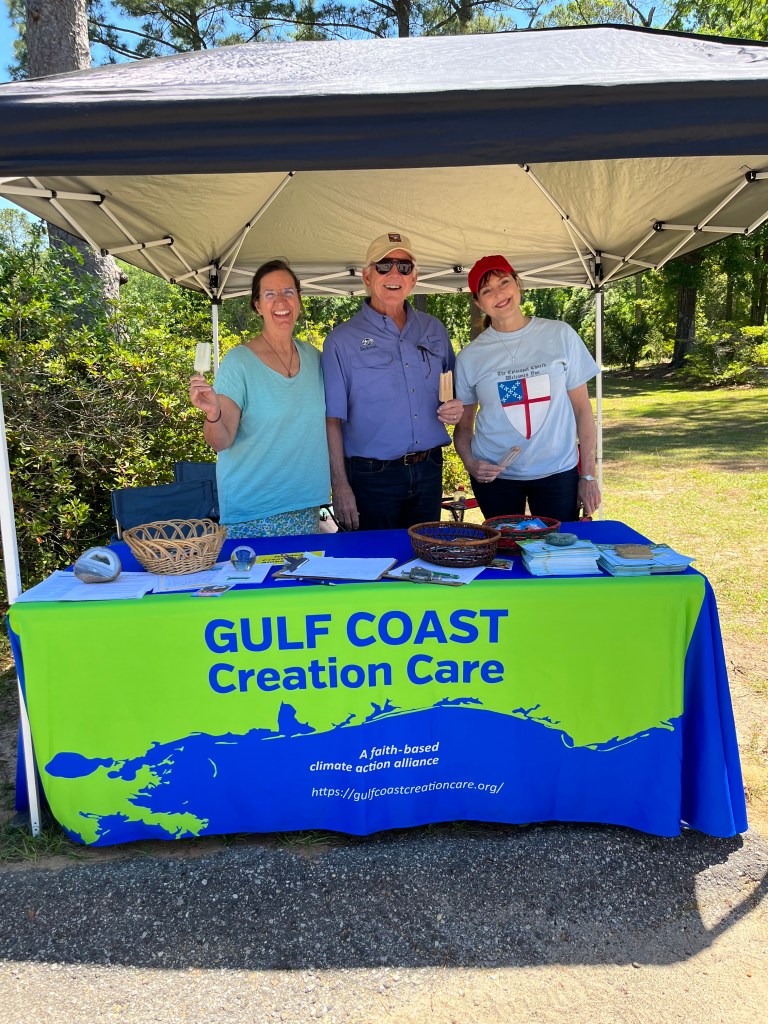
Gulf Coast Creation Care started after the 2019 reading of “Climate Church, Climate World” that so affected Vanderhart. Her Sunday school class, which combined members from her United Church of Christ congregation and a nearby Episcopal church, felt the need to respond in some way to the climate crisis.
“This is a big problem. We’re not going to solve it but we want to do something. It’s not going away,” she said.
GCCC now has around 10 member congregations, Vanderhart said. Like the IPL, Vanderhart said GCCC wants to connect with more people from all religious beliefs.
The Capacity Collaborative, while not a religious organization, partners with the IPL and PJC because they have shared goals of fixing environmental injustices and reducing energy burdens across the Southeast.
Kirkpatrick said the Capacity Collaborative started in 2022 to pursue grant funding from the EPA’s Environmental Justice Thriving Communities Technical Assistance Centers program. While they didn’t receive a grant, Kirkpatrick said they decided to continue the work anyway, providing technical and planning assistance to communities, especially rural ones, that are trying to solve sustainability and justice problems.
The Capacity Collaborative is also creating a regional science hub to support pro bono and volunteer science projects, which can help local communities get the data they need to understand and address their environmental issues.
RESILIENCE TO RESTORATION
A popular term in climate work is “resilience,” or the idea of making an individual home or a town better able to withstand rising sea levels, heat waves, droughts or other side effects of climate change. However, for the communities that are most vulnerable, Crider said, resilience isn’t nearly enough.
“A lot of resilience work to a frontline community is like saying, ‘We’re here to help you roll with the punches.’ No, we’ve got to stop pummeling these communities,” he said. “… You can’t win if you only play a defensive game.”
Kirkpatrick added: “There’s so many other needs that we can’t look at climate solutions in a vacuum. We’ve got to consider issues of poverty, food, health care, housing.”
Instead, Crider said the IPL and PJC prefer to aim for restoration: finding ways to make communities more environmentally and economically strong than they were before.
“We need to elevate them to a level of economic power and privilege that they have never enjoyed,” Crider said.
The PJC just wrapped up a restoration project through a federal grant from the National Academies of Science, Engineering and Medicine, Crider said, where they worked with communities from Texas to Florida on developing restoration plans, each tailored to its community, and hubs of restoration-focused resources.
Crider said the project was there to assist in pinpointing economic and environmental issues in each community, not to impose a rigid idea of what “restoration” means.
“We’re there to listen to them. They’re the local experts,” he said.
The PJC also received a small grant to turn that work into a toolkit that other communities can use to create their own restoration plans. Crider said his goal is to have at least six communities in each Southeastern state with these plans.
“There’s so many other needs that we can’t look at climate solutions in a vacuum. We’ve got to consider issues of poverty, food, health care, housing.”
Kathleen Kirkpatrick, Capacity Collaborative
Restoration can include tax credits and grant funding, infrastructure repair and improved public transit. It can mean projects like cleaning up industrial pollution, improving air quality and supporting green jobs, Crider said.
In Union Springs, for instance, there is a proposed project that would create a solar panel farm, electric vehicle charging station and training center for future renewable energy trade jobs. Crider called it “a shining example of what can happen when we transition from resilience to restoration.”
“We’ve really got to meet people where they are,” Kirkpatrick said. “… We’ve got to find leaders in communities who have the vision to catalyze green development and jobs.”
High-price upgrades like solar panels and electric vehicles aren’t feasible for many low-income homeowners and renters, Kirkpatrick said. However, making sure new homes are energy-efficient and can withstand severe weather, and helping homeowners find resources for smaller upgrades to reduce their energy bills, is another form of restoration.
“First thing you do is you plug the holes, then you see, ‘What can we do in terms of clean, affordable energy?’” Crider said.
While climate change is unmentionable in some parts of Alabama, Kirkpatrick said vulnerable communities get the picture because they’re already living with its effects. After the March 2023 hail storm in Camp Hill, for instance, she said volunteers who were putting tarps over damaged roofs also talked about how they recognized the growing trend toward more severe weather.
“People understand what’s going on. They might not always call it climate change,” she said.
ENERGY BURDENS
“Power and Light” are in the IPL’s name for a reason: high energy bills are a burden on families and on the environment.
“One of the most concrete and tangible things we can do is reduce the energy burden of the poorest sector of our society,” Guesman said.
Households that spend more than 6% of their income to pay their electricity bills are considered energy-poor. The U.S. average is around 3%, but some of the poorest families in the country devote as much as a third of their household income to keeping lights on and temperatures comfortable.
In 2020, more than a quarter of American families reported trouble paying their electricity bills, according to the U.S. Energy Information Administration.
“It’s people who are having trouble keeping the AC on in summer and the heat on in winter already, before a natural disaster hits,” Crider said.
According to the Department of Energy, the Southeast has some of the highest levels of energy poverty in the country, averaging around 10% of household earnings for low-income families. Alabama is among the top five states with the highest energy burden, along with Arkansas, Georgia, Mississippi and South Carolina.
The IPL has done mapping of energy poverty areas in Alabama. Unsurprisingly, Crider said, communities with heavy energy burdens are also likely to have other environmental hazards such as landfills and industrial pollution. That damage tends to follow the path of the least political resistance, Crider said, landing in the communities with no voice or influence to stop it.
“One of the most concrete and tangible things we can do is reduce the energy burden of the poorest sector of our society.”
Stephen Guesman, WERiSE
Decreasing a family’s power bills improves their financial health and quality of life — not to mention the environmental benefits of a smaller carbon footprint.
“Some of the poorest folks are paying 20% and up of their household incomes just to keep their lights on,” Guesman said. “… Reducing the energy burden of individuals is huge because they consume less energy and thus are contributing less to the climate crisis.”
The IPL advocates to the state’s Public Service Commission for more accountability from power companies and protection for consumers. It also has a fund to help pay low-income families’ energy costs in Alabama, through a partnership called Energizing Alabama for Energy Justice.
However, Crider said the WERiSE (Weatherize Every Residence in the Southeast) program has the potential to reach and help restore many more communities.
‘VERY SIMPLE STUFF’
Weatherizing a house is a straightforward concept, Guesman said. You want to keep the air-conditioned or heated air inside your home, and keep external air out.
“Most of that air sealing is very simple stuff. It’s literally just crawling over the house with tubes of caulk and cans of foam and knowing where to put it,” he said.
Once he’s sealed gaps in walls, attics and ductwork, “the house should be so tight that it would float,” Guesman said. Just sealing those gaps can reduce power bills by 10% or more, he said.
That simplicity has worked against weatherization’s popularity in some ways, he said.
Guesman has worked in construction off and on since the 1990s and has been certified in energy-efficient building practices. Expensive renovations like adding solar panels or installing new windows are easy for homeowners to see, he said, and that tends to be where the money’s at. It’s hard to make a living on a few hours of caulking and spraying foam, even if it’s the most effective method to save money.
“An energy-efficient home is more comfortable, and it’s also a healthier home. But all of those things, with the exception of the money, is fairly intangible for the homeowner,” he said. “… Almost all of it is invisible.”
But Guesman and Crider are hoping that very same simplicity will be a benefit for the WERiSE weatherizing program.
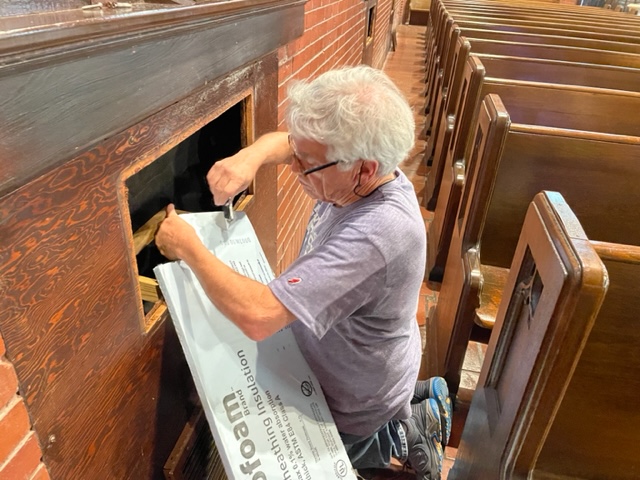
WERiSE is intended to be a “train the trainer” model, Crider said, giving people knowledge that they can take home and share with others. Guesman serves as the WERiSE technical director and local churches host the clinics.
“It really is so simple that I could teach it in the course of two to three hours in the morning,” Guesman said. “… Ideally, we send you home with a caulk gun and a can of foam and knowledge of where to put it. And that’s not an energy makeover, but it’s a start.”
After a WERiSE class, Guesman said he hopes some people will feel motivated to make more energy efficiency changes at home. The rare person, he hopes, could turn it into a job and lead weatherization efforts with a renovation crew in their own community.
Sharing the skills will reach farther than Guesman could on his own with a caulk gun.
“We’re wanting to teach that, not just do it,” he said.
With a recent increase in federal funding for this type of work from programs like the Justice40 Initiative, Guesman said the timing is right for something like WERiSE to spread far beyond Alabama.
“It’s huge what that’s going to accomplish,” he said. “… This program is just perfectly tailored for the times.”
WERiSE was originally planned to launch in spring 2020, but the COVID-19 pandemic delayed it until 2022, Guesman said.
The first group that wanted to host a WERiSE clinic was Gulf Coast Creation Care.
At the three sessions GCCC has hosted so far, Vanderhart said, Guesman has assessed each host church’s energy efficiency and attendees come back after the session to put their newfound sealing knowledge to work.
“The churches really love it because they can lower their energy bills,” Vanderhart said.
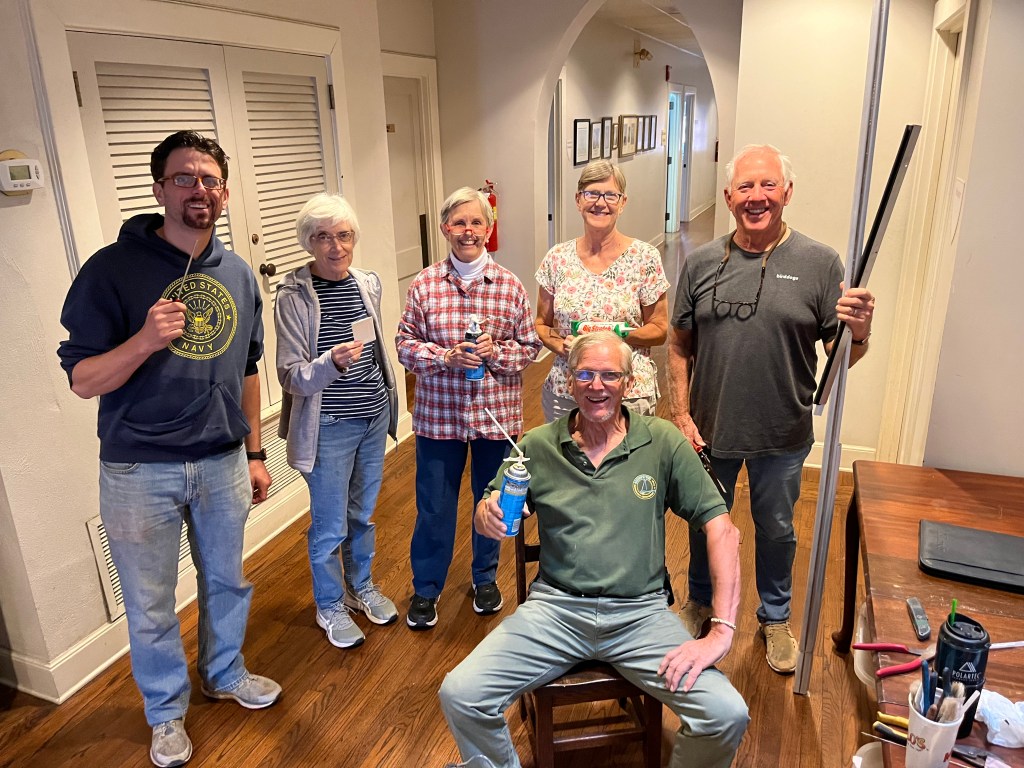
While the churches are enthusiastic, Vanderhart said they haven’t gotten as much traction with the sessions as she hoped. GCCC is still trying to find a person interested in turning weatherization into a job, as well as funding sources to provide the work for homeowners who can’t afford it.
“It’s not glamorous work. Crawling around in an attic or crawlspace and sealing people’s ducts and cracks, it’s tedious,” she said.
Crider said Camp Hill has also hosted a clinic, and the IPL hopes to partner with the Africatown community in Mobile to host one, too.
Guesman said they’re still learning and building WERiSE’s foundation through these early clinics, some of which he admitted have “missed the mark.” Some clinics were in communities where there was no one who could take the knowledge and then train or provide weatherization services to others, he said. Sometimes participants don’t follow through on implementing what they learned.
Others don’t own their own homes or can’t do the energy efficiency work themselves.
“Some of the more needy are people who can’t do this program. They need services — for God’s sake they need services — but they’re not in a position for the do-it-yourself of WERiSE,” Guesman said.
Guesman said the IPL will write grants to fund weatherization in those communities, but that has limited reach.
“We’re trying to teach so when the grant money and us are gone, there’s that lingering expertise in the community that they can do it themselves,” he said.
Addressing rental properties might require a whole separate program, which WERiSE doesn’t currently have capacity for, he said.
Despite the obstacles, Guesman said they press forward in hopes of finding the right teaching methods, the right communities and the right individuals to fulfill the goal of weatherizing every home in the Southeast.
FAITH IN ACTION
There are “a million things that you can do in climate work,” Vanderhart said, and people who share their faith through each of those actions.
Crider pointed to the good work of people like Warren Tidwell of ACROSS Alabama. After severe weather, Crider said, Tidwell brings his Prius, a mini-fridge and a power strip to affected communities and parks there to provide a charging station and refrigerated storage for medicines like insulin.
“This is his life’s work,” Crider said.
The Faith and Works Statewide Civic Engagement Collective is a partner in the IPL’s Energizing Alabama for Energy Justice initiative, along with its other civic and racial justice efforts.
The Episcopal Diocese of Alabama has a Task Force for Creation Care. Some of its work includes offering mini-grants for churches to become more sustainable and planting trees throughout Alabama as part of the international Communion Forest project.
Crider is also trying to launch an Alabama chapter of the Union of Concerned Scientists.
Gulf Coast Creation Care sees its two major goals as raising awareness of climate change and reconnecting people to nature, Vanderhart said.
GCCC has helped host and promote electric vehicle showcases in Mobile and has an annual Lent email newsletter of climate action and inspiration, she said.
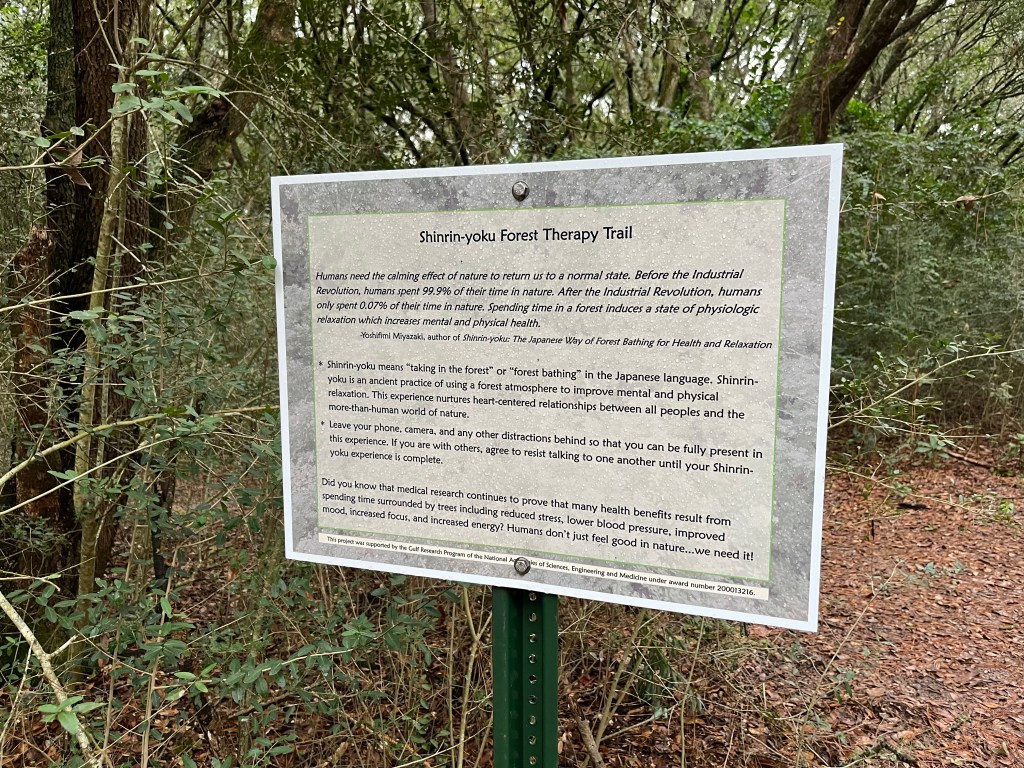
With grant money from the IPL, Vanderhart said the GCCC has put up forest therapy trail signs at Five Rivers Delta Resource Center, Beckwith Camp & Conference Center and the Mobile Japanese Garden, with a fourth location still to be determined. Forest therapy trails are intended to encourage mindfulness, relaxation and engagement with nature.
“For a small group of people, I’m amazed at what we have accomplished,” she said.

In the future, Vanderhart expects that GCCC will have a role to play in taking care of climate refugees: those who have to flee their homes due to natural disasters or unlivable conditions.
“We see ourselves as being part of a group that takes care of displaced people. We think that’s going to become an issue someday, and churches and faith-based organizations that believe we should care for our neighbor will be on the front lines of that,” Vanderhart said.
THE LONG HAUL
Climate change can’t be fixed with just one solution, Crider said, whether it’s recycling or renewable energy or home efficiency. It’s also impossible to care about the environment without caring about humanity, he said.
“I’ve been a tree-hugger all my life, but I’ve been educated about the people component, the justice side, late in life,” he said. “… It is all about making sure that people as well as planet are placed over profit.”
Sustaining their efforts “for the long haul” and fighting that crisis fatigue is also essential, Vanderhart said. Individuals’ efforts and commitment in a group like Gulf Coast Creation Care may ebb and flow, she said, but they continue to stay the course.
“We give each other a lot of grace,” she said. “… I want us to be a nurturing space, and I want people to be drawn to that.”
Main article image courtesy of Phillip Pessar, via Wikimedia Commons.
 Southern Science
3 thoughts on “Faith for the future”