

Program teaches kids about science, justice in Africatown
by Sydney Cromwell
Healing gardens. Sea kayaks. Drone soccer.
They’re all part of STEMMing the Tide, a project that aims to change school curriculum and get middle schoolers engaged in science and environmental issues — right in the midst of a community that has faced some of the greatest environmental injustices in Alabama.
‘LOST IN THE PIPELINE’
In her chemistry courses at the University of Montevallo, professor Kate Hayden said she’s always looking to encourage young scientific leaders, especially students from racial minorities or lower-income families, who aren’t as represented among the ranks of professional scientists.
But college is too late to capture their attention, she said.
“If I want to promote diversity, especially in administrative levels, … I’m looking at trying to get people of different backgrounds or different colors to get their M.D. or get their Ph.D.,” Hayden said. “… But if none of those students are in my classroom, then that doesn’t matter. I’ve already lost them in the pipeline.”
According to 2021 research from Pew, Black students earn only about 7% of the STEM (science, technology, engineering and math) degrees awarded each year, and Hispanic students earn about 12%. Nearly 70% of jobs in STEM fields are held by white people.
Hayden and Roald Hazelhoff, the executive director of the Southern Environmental Center, decided that they needed to start earlier in students’ lives to create that love of science. According to Alabama’s 2022-2023 state report card, less than 40% of students were proficient in science and only 30% were proficient in math.
Black students had the lowest proficiency levels (19% in science, 13% in math) of any racial group. Difficult life circumstances, such as homelessness, economic disadvantage, disability or limited English-language skills, were consistently tied with some of the lowest proficiency scores in the state.
“There’s something wrong with the state curriculum that we’re not reaching these students,” Hayden said.
She and Hazelhoff looked toward middle school as an opportunity for a new approach.
“A lot of STEM-engaged curriculum development gets focused on K-5, right, because it’s fun to work with little kids and make them excited about science,” Hayden said. High schoolers, too, get focused efforts in the form of internships and more advanced — and attention-grabbing — experiments in the classroom.
“Middle school kind of gets left out,” she said.
At Mobile County Training School, only about 17% of middle school students are proficient in science. Less than 2% are proficient in math.
Part of the problem, Hayden and Hazelhoff felt, was that the current science curriculum just wasn’t all that interesting to middle school students. They needed a way to feel connected to what they’re learning.
“To make it truly engaging, we have to center it on students’ homes,” Hayden said.
Hayden and Hazelhoff created the STEMMing the Tide project to test that idea, through a $1.25 million grant from the Gulf Research Program of the National Academies of Sciences, Engineering and Medicine. They started with the community of Africatown, a historically Black neighborhood of around 2,000 people north of Mobile, and its middle school, the Mobile County Training School.
Rather than reading in a textbook about Chesapeake Bay, hundreds of miles away, Hayden and Hazelhoff thought students might get more engaged if they could learn about the Mobile Bay right next door. The water cycle, the food chain, climate change, habitat loss, industrial pollution — it’s all happening where they live, Hayden said.
“Kids, and to some extent teachers, don’t even really know their own backyards,” Hazelhoff said. “The idea of mapping, the idea of air quality, water quality, soil quality analysis that is local in nature but connects to surrounding industrial plants, prevailing winds, … that creates better environmental citizens.”
OVERLOOKED
Getting to know Africatown’s backyard means facing a long history of environmental problems, reaching back to its founding by former slaves who were illegally brought to Mobile in 1860.
Like many poor and minority communities in the U.S., Africatown for decades has been a landing spot for heavy industry that no one wants to live near. That includes oil storage tanks and manufacturers of paper, lead pipes, tires and tar. Railroad lines run through Africatown, and a tar sands pipeline was placed under the Mobile County Training School property.
“There is a lot of environmental injustice in our own backyard,” Hazelhoff said.

Emissions, chemical runoff and industrial waste have been polluting Africatown for a long time, and residents believe it’s caused higher rates of cancer and other illnesses, Hayden said.
In 2017, about 1,200 Africatown residents sued International Paper, alleging that it had released illegal amounts of toxins into the air while the mill was operating and that the company failed to properly clean up the site when it shut down. However, International Paper denied the allegations and soil testing didn’t show elevated levels of toxins, so the paper company settled the suit in May 2020. Later testing after the lawsuit has shown higher levels of carcinogens in the soil, according to Baheth Research and Development Laboratories.
In 2021, residents petitioned for changes in Mobile’s zoning and development codes to protect Africatown from further industrial development. This February, the Alabama Department of Environmental Management held a public hearing on resident complaints about pollution from the nearby H.O. Weaver & Sons asphalt plant.
“A lot of times, the people in that part of our city are overlooked,” said Mark Berte of the Alabama Coastal Foundation, which has been a partner with STEMMing the Tide since its start.
Mobile County Training School, which has around 250 students in grades 6-8, is 96% Black and 98% economically disadvantaged, according to its most recent state report card. Only about 17% of MCTS students are proficient in science. Less than 2% are proficient in math.
Teaching MCTS students about the history and science of environmental injustice in their own neighborhoods isn’t just about improving their state testing scores. Hayden said she wants students to learn that they can have a voice and a role in fixing problems in their community, even from a young age.
“Hopefully, we’re changing the landscape, and by changing the landscape, bringing it back to what it was before all the industrialization, that will help encourage the students.”
Kate Hayden, STEMMing the Tide
Taking water quality samples or studying native plants from a kayak in Mobile Bay might also plant the seed of future careers, leading to that pipeline of diverse talent that Hayden hopes to see in her classroom.
“The more you get people excited at that age with what they could do with a science degree, the more options open up for their world and giving back to our coastal Alabama,” Berte said.
Bringing more diversity to science has benefits beyond broadening individual students’ career options, Hayden said.
Scientists and research institutions make choices every day about what to study and what research get funded and eventually published. If everyone making those choices comes from a similar background, their perspectives may end up unintentionally excluding worthwhile research, she said.
CREATIVE CLASSROOMS
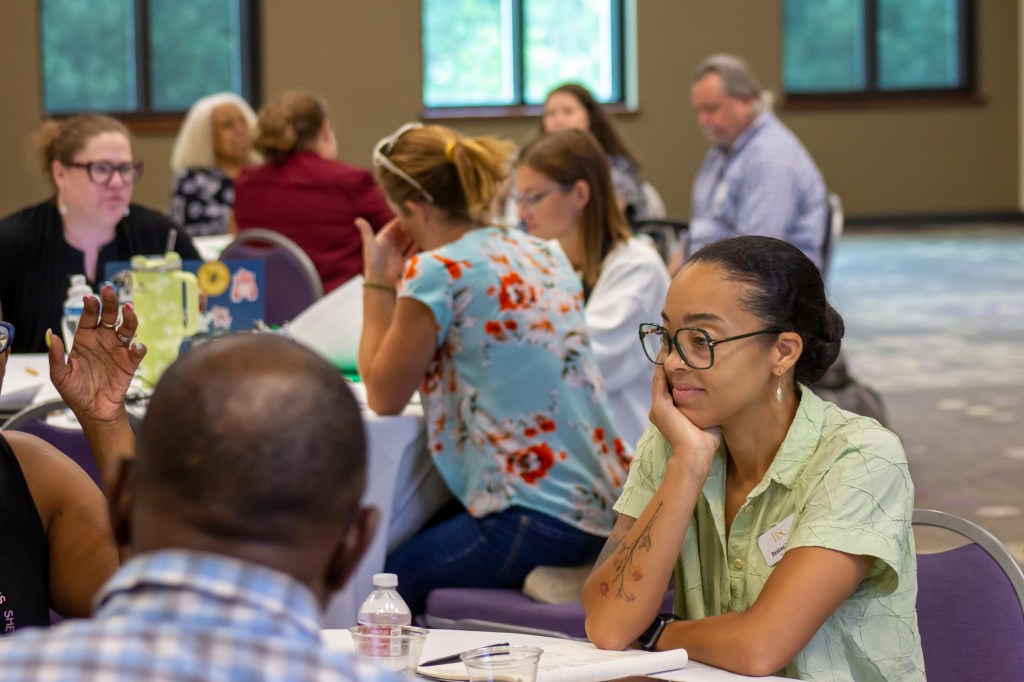
STEMMing the Tide launched during the 2022-2023 school year, bringing together middle school teachers, school administrators, community partners and university researchers to reinvent science and social studies curriculum in MCTS classrooms.
Hayden said the teachers and administrators bring knowledge of the state’s testing standards and what their classrooms need. Community organizations, like the Alabama Coastal Foundation and Mobile Environmental Justice Action Coalition, bring local and environmental awareness. And everyone involved — from the health department and a neighborhood Baptist church to graduate students and an Africatown resident who’s a master gardener — brings fresh ideas, she said.
The first summer workshop included five teachers from MCTS, Hayden said, and the second summer had 10 from MCTS, Barton Academy and Vigor and Blount high schools. The teachers take the lead in these workshops, choosing a topic to focus on and then getting help from partners to find new ways to teach the topic that meet state standards and include issues of justice and community connection.
“The teachers are amazing. The level of support we’ve gotten from the teachers and the enthusiasm to want to do this work, … the love they have for their students is so evident,” Hayden said.
One teacher, for example, chose flooding causes and management as her topic, Hayden said. Floods are a problem in Africatown, sometimes preventing kids from getting to school when the stormwater sewers are overwhelmed or water pipes leak.
With help from Mobile Baykeeper, Hayden said, the teacher designed a lesson plan where students would learn to use water tables to study flooding and then build a water table that looks like their neighborhood, so they could explore how and why it floods and what might prevent or reduce the impact.
“It’s a great opportunity for teachers to design something that is theirs and that they think their students will enjoy,” Hayden said.
She said she’s seen teachers at the point of tears because they’re excited about the new curriculum ideas and the support that has come out of those workshops.
“Teachers don’t have the capacity, they don’t have the time or the resources or the space to design an innovative curriculum. They want to, they would love to,” Hayden said. “… It’s the reality of our workload, so bringing in the community helps kind of offload some of that.”
STEMMing the Tide also provides grants or stipends to help teachers attend the workshops and do necessary research or make purchases they need for their lesson plans.
The basic framework for the STEMMing the Tide curriculum builds on students’ knowledge by grade level.
In sixth grade, students hear from the different community partner organizations, who do talks and demonstrations to introduce kids to the work they do and the environmental challenges of the area.
During the summer, the sixth graders also go to a free Estuary Corps summer camp through the Alabama Coastal Foundation. They take kayaks out into Mobile Bay, learn about beach ecosystems and visit the Dauphin Island Sea Lab, Hayden said, “places that they’re really close to, they’ve seen, but a lot of them may have never been.”
“They get a really good, broad overview, but an in-depth overview, of our coastal environment but also different jobs,” Berte said.

Berte said it’s always fun to see the kids open up over the course of the camp.
“That age group, you know, people are very apprehensive, let’s just say, to share. But once you give them the space to really ask questions and really speak to their hearts as to what they could see themselves doing in the future, they really do open up,” he said.
In seventh grade, the teachers’ new lesson plans enter the mix.
Hayden said one teacher had the idea of teaching her students to use drones to map their neighborhoods, learning how to identify things like green spaces, flood zones and pollution sources. STEMMing the Tide helped purchase the drones, and a competitive game called “drone soccer” will teach the students how to fly them.
A special education teacher decided to set up an aquaponics system in her classroom, Hayden said, and her students help care for the fish and the plants they’re growing. They recently had their first fish fry.
Another teacher decided to have her students plan and build miniature “healing gardens,” which include plants that have been used historically for medicinal or therapeutic purposes, at Africatown’s Heritage House and Museum.
From what Hayden hears from the teachers, their new curriculum seems to be capturing kids’ interest. The teacher who built the healing gardens had a student suspended for fighting, and when he came back, he was worried about whether he had missed the chance to create his garden, Hayden said.
STEMMing the Tide also funded a composting program and a new science lab at MCTS and helped create an outdoor classroom and bioswale, to control rainwater runoff, at the Heritage House, Hayden said. They’re working on planting climate-resilient trees to shade the outdoor classroom and encourage the return of native birds.
“Hopefully, we’re changing the landscape, and by changing the landscape, bringing it back to what it was before all the industrialization, that will help encourage the students,” she said.

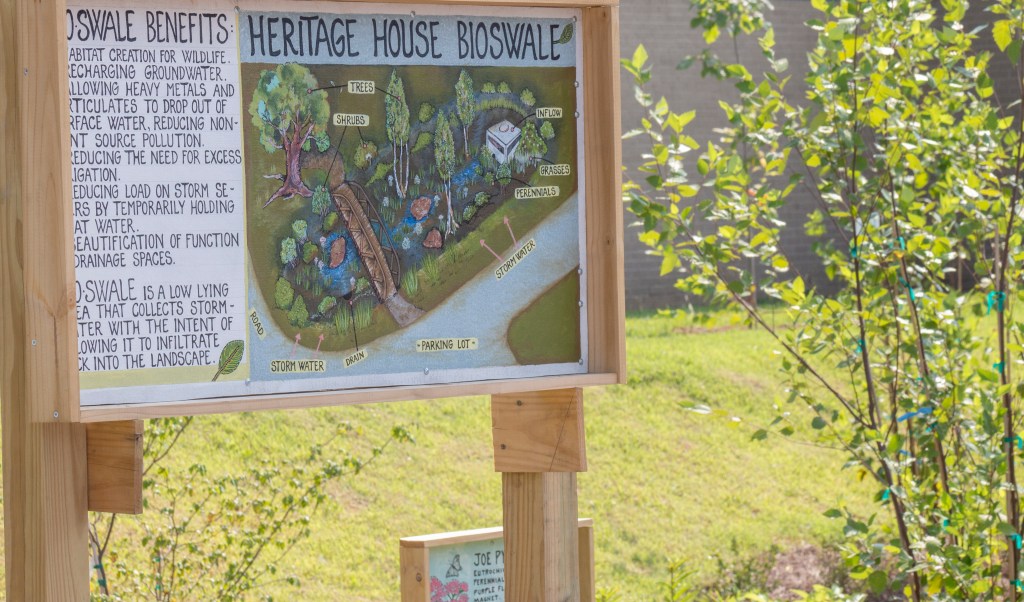
Hazelhoff said bringing these projects outside the classroom, like having gardens at the museum or playing drone soccer at the community center, is a way to get others in the community invested in what’s happening.
In eighth grade, the students choose a “capstone” service project that addresses one of the environmental issues they’ve learned about in previous years. Each student writes a proposal and works with a community partner to plan and enact their project, then measure the impact they’ve had.
The pilot class of students, who were sixth graders in the first year of the program, are now getting ready to enter eighth grade. Hayden said she’s looking forward to seeing what they come up with for their capstone projects and how those changes might ripple out around Africatown.
Hayden said that by “empowering them to feel like they’re making a positive change in their community,” she also hopes kids will get excited about learning the science behind their projects.
Bringing topics like environmental and racial injustice into the classroom has been fought by some school boards and state education departments around the country, including in Alabama. According to Hayden, STEMMing the Tide hasn’t seen that kind of pushback, and the program has had steady support from the school board.
“We try to avoid shame triggers,” she said. “… We talk about the reality of things. We have the data to back it up. We’re talking about the history of Africatown, which can’t be disputed. We keep it very forward-looking.”
FUTURE LEADERS
As the STEMMing the Tide program becomes established over the next few years, Hayden hopes to see it pay dividends in the form of higher proficiency scores from MCTS students in the state’s standardized testing.
“If we can do that in a troubled school system and empower teachers to take steps on their own, that’s a success for me,” Hazelhoff agreed.
If the program works as they hope, Hayden said the next step is to broaden its reach and help more teachers develop their localized, community-focused curriculum.
In Africatown, she said the program could expand in both directions in the future, to reach elementary classrooms and address learning gaps they see in incoming sixth graders, and to advance the curriculum to keep students engaged with science through high school.

At the start of 2024, Hazelhoff started the Birmingham Urban Watershed STEMM Initiative, modeled on STEMMing the Tide, with 11 schools in Birmingham’s Village Creek watershed. The schools, which range from kindergarten through high school, have similar racial and economic demographics to the Mobile County Training School. They also have similarly low middle school math and science proficiency scores.
The Birmingham pilot program is smaller, Hazelhoff said, though it has some of the same staff involved. He said his goal is to establish the program for a couple years and then let others take it into the future.
“My hope is that they become aware and confident that they can pursue careers, whether it’s urban agriculture or science research or nonprofit work, to galvanize more people, because Alabama is a state in denial [about environmental issues], right?” Hazelhoff said. “There’s a sense of urgency here, we’ve got to get going.”
Main article image of an Estuary Corps summer camp activity courtesy of STEMMing the Tide.
 Southern Science
One thought on “Environment in the classroom”