New funding to turn former mines into ecological, development opportunities
by Sydney Cromwell
Take a look at the eastern bank of the Cahaba River near West Blocton, and you’re likely to see deer and turkeys, young trees leafing out and perhaps even the Cahaba lilies blooming on the shoals, if your timing is right. Look at the Sicard Hollow area of Vestavia Hills, and you’ll see children playing on soccer fields or a splash pad, pet owners at the dog park and a runner or two on the trails.
What you won’t see is the definitive scar that used to mark these two sites and dozens of others in Alabama’s coal country: the highwall, a sheer cliff face, dozens of feet high, left behind by the destruction of strip mining.
Abandoned mines are a safety hazard. But in their cleanup, there is also the potential for environmental restoration and new possibilities.
DANGERS LEFT BEHIND
When a coal mine is abandoned, the features that made mining easier become a liability to people and property. Dustin Morin, the mining and reclamation division director for the Alabama Department of Labor, said he gets an average of one emergency complaint each month about a hazardous mine that gets added to the statewide inventory.
“It’s not one of those things where we constantly chip away at it and the number goes down. We’re constantly finding new abandoned mine features,” Morin said.
Highwalls are one of the most common dangers that the state’s Abandoned Mine Reclamation (AML) program has to deal with. They are created by mining equipment stripping away layers of earth to access underground coal seams, leaving behind a sheer wall of soil and rock. Highwalls can be dangerously unstable, especially if there are buildings nearby.
At the Sicard Hollow site, for instance, “there were some really serious safety concerns and hazardous conditions left by the mining activities from the past” before the site’s highwall was reclaimed around 2012, according to Vestavia Hills City Manager Jeff Downes.
Underground mines can also lead to sinkholes as the ground shifts and settles around the mine shafts left behind. The coal waste piles left behind by mining activity in the late 1800s and early 1900s create a fire and air pollution hazard during wildfires, another problem that the AML has to address.
“Coal smoke is pretty noxious, especially Alabama coal,” Morin said. “It has a high sulfur content. It stinks. It’s not healthy to breathe.”
Water pollution, landslides and underground mine fires are other safety considerations, according to the federal Office of Surface Mining Reclamation and Enforcement (OSMRE).
HOW TO ERASE A MINE
The intent of mine reclamation, Morin said, is first to get rid of any safety hazards, then to either restore the site to near-original condition or make it ready for a new use.
“The goal of the AMLER [Abandoned Mine Lands Economic Revitalization] program is to create some sort of economic development potential or some sort of community impact potential,” he said.
With a constant “ebb and flow” of projects, Morin said the AML tries to prioritize the most unsafe mine sites first, while more minor safety or environmental hazards tend to wait longer.
“In simplest terms, what raises priority is proximity to people,” Morin said.
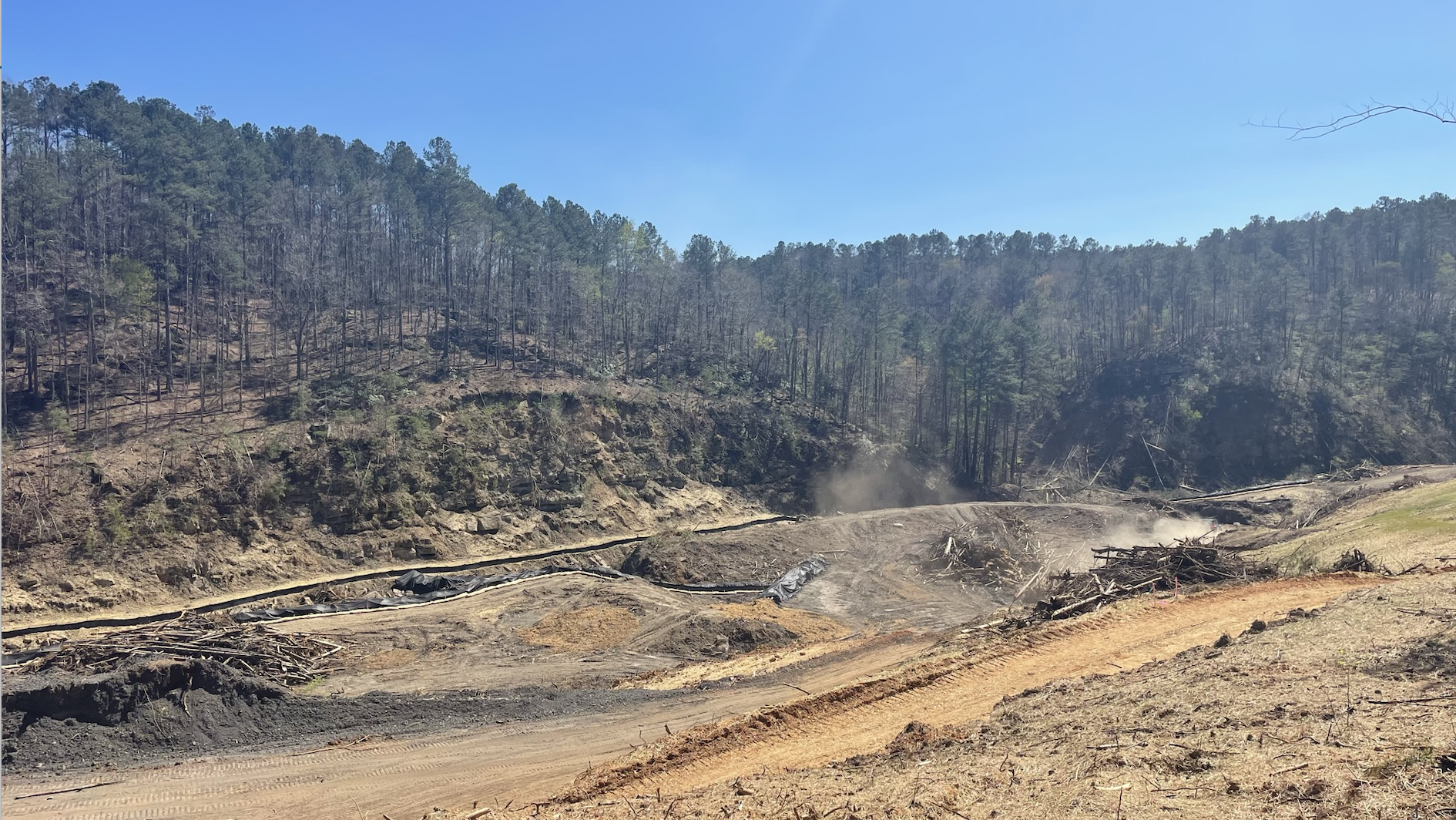
A reclamation project might include tearing down a highwall; stabilizing soil; filling in sinkholes and pits; covering or moving waste piles; installing new drainage to control water runoff; or treating soil and water for metals, high acidity and other pollutants from the mine site.
“These are very complex, civil engineering design projects,” Morin said.
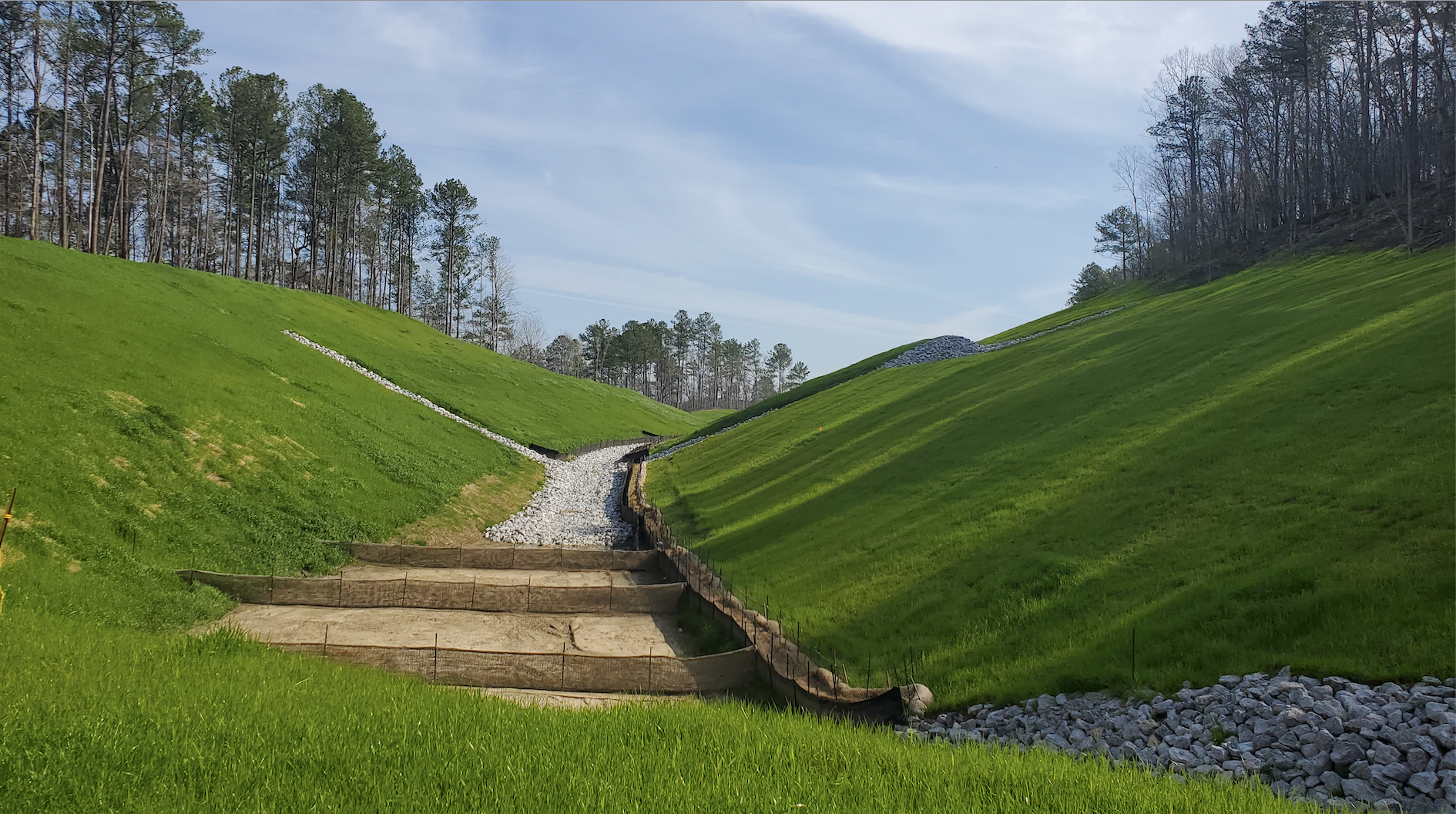
Reclamation often ends with new soil and reforestation to restore some of the ecology that was lost. The AML office can use old topographic maps and Lidar imaging to get a rough idea of how the land looked before it was mined, Morin said.
“It’s not completely natural, but it’s as approximate to natural as we can get,” he said. “… It will definitely look constructed, at least for a brief period of time until the trees come back.”
Since most mine reclamation projects are on private property, Morin said they try to take into account what the owner plans to do with the land, such as using it for livestock pasture or timber.
After a reclamation project is complete, Morin said the AML will monitor the site for a minimum of two years to make sure no new problems arise.
Some recent reclamation projects across the state include an agricultural restoration in Walker County, the Hillsboro Sports Complex in Shelby County, Grand River Technology Park in Jefferson County and North Fork Creek and Eagle Cove Marina, both in Tuscaloosa County. Alabama’s AML office received federal recognition in 2019 for putting out a mine fire in Bibb County and in 2020 for reclamation of a mine at Ruffner Mountain Nature Preserve in Birmingham, which included preserving habitat for tricolor bats.
When the AML program gets started on a new reclamation project, Morin said the staff sometimes has to decide between a quick “band-aid” solution, which addresses only the most urgent, immediate problems, and a more comprehensive solution that could prevent future issues.
Making that decision usually comes down to budget, he said — and until the last couple years, funding for Alabama mine reclamation has generally leaned toward less rather than more.
‘THE BEST FIX WE COULD AFFORD’
A little history is needed to understand how money has influenced mine reclamation.
The federal Abandoned Mine Land Reclamation program can reclaim any “legacy” mines that became inactive prior to 1977, and it provides funding to states and tribes for these projects. The program was established by the Surface Mining Control and Reclamation Act (SMCRA) that same year.
SMCRA also established a fee-based system to generate that funding, by charging mining companies a fee per ton of coal they produce. The proceeds from those fees are distributed to states and tribal authorities based on their current and historical coal mining operations.
Alabama still has an active coal mining industry, with nearly 11.3 million tons of coal produced in the 2023 fiscal year, according to the state’s Office of Mine Safety and Inspection. In addition to their fees, mining companies are also responsible for the reclamation of post-1977 mining sites.

The fee-based system funded most of Alabama’s mine reclamations from 1977 to 2021, Morin said.
Around five years ago, he said, the state AML was getting about $3 million per year in fees, enough to typically complete one to three large projects annually.
Since 2016, the federal AML Economic Revitalization program (AMLER) has provided additional grants for reclamation projects that boost economic and community development. Alabama has received around $10 million per year from that program since 2017, and last year the state was awarded $11.7 million.
Meanwhile, Alabama’s inventory of unfunded reclamation projects hovers around $450 million across 21 counties, Morin said.
“We have way more abandoned mine land inventory than we’ve been given grant money to address it,” he said.
That led to “band-aid” fixes to try to stretch their budget.
“We would go in and essentially put in the best fix we could afford,” Morin said.
The fee-based funding system, which has been extended seven times since 1977, was set to expire in 2021. In response, Morin said, the mining and reclamation division had been slowly tapering down its staff and leaving positions unfilled to prepare for their future downsized budget.
Instead, they received an infusion of new cash from the 2021 Infrastructure Investment and Jobs Act.
“When they passed this infrastructure law, that kind of changed our calculations a little bit,” Morin said.
NEW MONEY, NEW FIXES
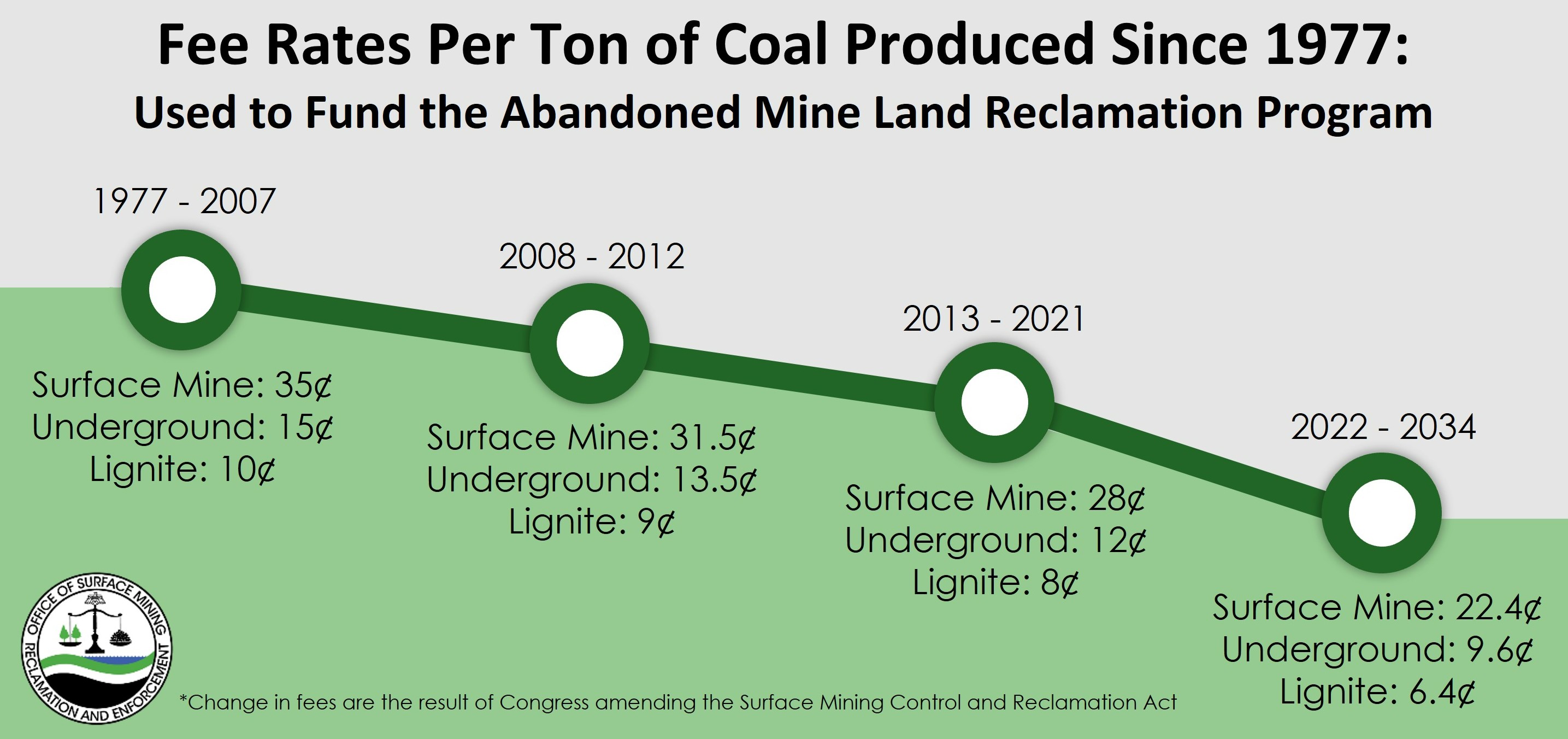
The Infrastructure Act extended OSMRE’s collection of coal company fees through 2034, although the per-ton rate was reduced by 20%. This is the third time that the fee has been reduced during its lifetime.
The key part of the bill from AML’s perspective, though, was an entirely new revenue stream of $11.3 billion in reclamation funding over 15 years. By comparison, OSMRE has awarded around $6 billion total in funding since it was established in 1977.
Last year was the first that Alabama received its portion of these new funds, which totaled an extra $20.4 million. Over the next 15 years, the state should receive approximately $300 million for mine reclamation.
While that’s not enough money to entirely clear Alabama’s abandoned mine inventory, Morin said it opens the path to complete more projects and implement better solutions.
“The hope is that we will eliminate most of these high-priority sites over the next 15 years,” he said.
“We have way more abandoned mine land inventory than we’ve been given grant money to address it.”
Dustin Morin, Abandoned Mine Land Reclamation program
After years of letting the AML staff decline to match budget expectations, Morin now finds himself in the position of trying to quickly double or triple his office’s size. He estimates that they’re probably about a year away from being fully staffed.
“We had become very small. … We were below 10 people. Now we’re trying to staff up to 25 to 30 people,” he said.
With new money comes a new approach to reclamation, Morin said. For example, rather than putting out a mine fire, Morin hopes the AML staff will be able to identify potential fire hazards and fix them before the fire starts. Rather than filling in a single sinkhole, Morin envisions surveying an entire property to find spots that are likely to become sinkholes in the future.
“What this funding allows us to do is go in and put in a permanent fix. … We don’t have to be as conservative with our reclamation projects,” he said.
The AMLER grants that Alabama has received since 2017 have enabled a few of these kinds of comprehensive fixes, such as fixing water quality at North Fork Creek or preparing the Grand River Technology Park to be suitable for development.
A mini-grant from AMLER to the Cawaco Resource Conservation & Development Council also funded better mapping of Alabama’s abandoned mine sites, which has guided some of the AML projects.
With their new budget, Morin said the state AML program’s capacity should be much greater.
“I would imagine in a couple more years, we’ll be doing 25 to 30 of these projects a year,” he said.
WHAT’S MINE IS OURS
Two recent reclamation projects, the Piper Mine site and the Pine Ridge site, are examples of what Morin foresees for the future of the Alabama AML program.
The Piper Mine is a property that has been part of the Cahaba River National Wildlife Refuge in Bibb County since 2001, according to refuge manager Steven Trull.
It’s actually the third phase of mine reclamation at the refuge, Morin said, which has been accomplished through partnership between the AML office, the U.S. Fish and Wildlife Service and the Cahaba Riverkeeper organization.
The first phase occurred in the 1990s and the second phase in 2014, both of which had to focus on only the most urgent problems.
“We couldn’t go in and completely address the site as a whole. We kind of had to look at the worst AML project we were aware of at the time,” Morin said.
During the second phase of reclamation, Morin, an inspector at the time, recalls thinking that they would never have the funding to fix up the Piper Mine site.
“I never thought we’d be able to accomplish phase 3. It was a very rough, inaccessible area,” he said. “We weren’t sure what our ability to reclaim that would be.”
With $7.9 million in 2023 AMLER grant funding, however, not only were they able to remove the dangerous highwall — which was 100 feet tall in some places, Morin said — and waste piles on the site, but they could also make the site into a recreational and environmental amenity.
“When Alabama got included with the AMLER program, … it kind of expanded the scope of what was possible to achieve out on the refuge,” Morin said.

The Piper Mine site finished construction earlier this year and opened with a ribbon cutting in April.
The former mine site now has hiking trails, canoe launches and signage. Young trees and native species have been planted, with plans to introduce longleaf pine habitat to the site. A 10-acre pond on the site, formerly contaminated with sulfuric acid, now has fish swimming in it, and Trull said they plan to stock it with more.
“You can’t even tell now that there was a highwall out there. It’s got a nice gentle slope to it,” Morin said.
Trull and Cahaba Riverkeeper David Butler said it’s an environmental win for the native landscape, the wildlife and the Cahaba River, which is now protected from polluted runoff by changes made to the site’s drainage.
“Right now, the wildlife is loving it,” Trull said. “… There’s a lot of happy critters.”
However, it’s also a boon to the people who visit the refuge, especially during the annual Cahaba Lily Festival, he said. Traffic and parking are always difficult while the lilies are blooming, Butler said, making the road into the refuge “almost impassable.”
The Piper Mine site offers a new access point for visitors to park and see the lilies.
“This area of the refuge has been something we’ve certainly wanted to address. The community has not had access to it for a long time because of the dangers left behind by the highwall,” Butler said. “… This is going to give people the opportunity to see the refuge in a more natural way.”
In turn, the success of the festival is an economic boost for nearby West Blocton, which lost jobs over the years as sites like Piper Mine shut down, Butler said. The refuge also provides year-round access to hunting, fishing and hiking.
“This is a really significant development for the town of West Blocton,” Butler said.
Because the reclamation is so recent, Trull and Butler said the Piper Mine area looks visibly different from the surrounding refuge property right now. A lot of invasive plants had to be pulled up to make room for native species. But given time to grow, the reclaimed land should eventually be indistinguishable from the land around it.
“You can’t get to the ultimate goal if we don’t go backward and get rid of the invasive species,” Butler said. “Twenty years from now, the grass will all be gone, trees will all be planted, it will look drastically different, but we couldn’t get back to that point if we didn’t go backward first.”
“This area of the refuge has been something we’ve certainly wanted to address. The community has not had access to it for a long time because of the dangers left behind by the highwall.”
David Butler, Cahaba Riverkeeper
Butler said the Riverkeeper plans to continue monitoring water quality in the area to watch for sediments and other pollutants, including through its annual Swim Guide.
“But we’re pretty optimistic that a lot of the issues that we saw before are not going to be problems going forward,” he said.
The reclamation work done at Cahaba River National Wildlife Refuge is the largest project that’s been done anywhere in the state, Morin said. Across all three phases, AML removed 1.7 miles of highwall and recontoured nearly 110 acres of land at the refuge.
With its impacts on people, wildlife and water quality, “to me, there’s no better project than one like this,” Trull said.
BALANCING NEEDS
Pine Ridge, which was funded alongside Piper Mine by the 2023 AMLER grant, is another multi-phase project, but it’s destined for the other side of the reclamation coin: economic development.
The city of Vestavia Hills started its first reclamation project in that area in 2010, eventually turning 65 acres of abandoned mine property into the site of the Sicard Hollow Athletic Complex, a dog park, picnic pavilions, pickleball courts, a splash pad and nature trails.
The first phase was building the athletic complex away from existing highwalls on the property, city manager Jeff Downes said. In 2012, the AML program addressed the highwalls and other safety concerns, which opened up the rest of the property to build more “passive” recreation through further grants in 2016, 2017 and 2018, Downes said.
“This recreational use is probably a good, careful balancing of taking what were problematic lands and making them productive and meeting the demands of the city,” he said.
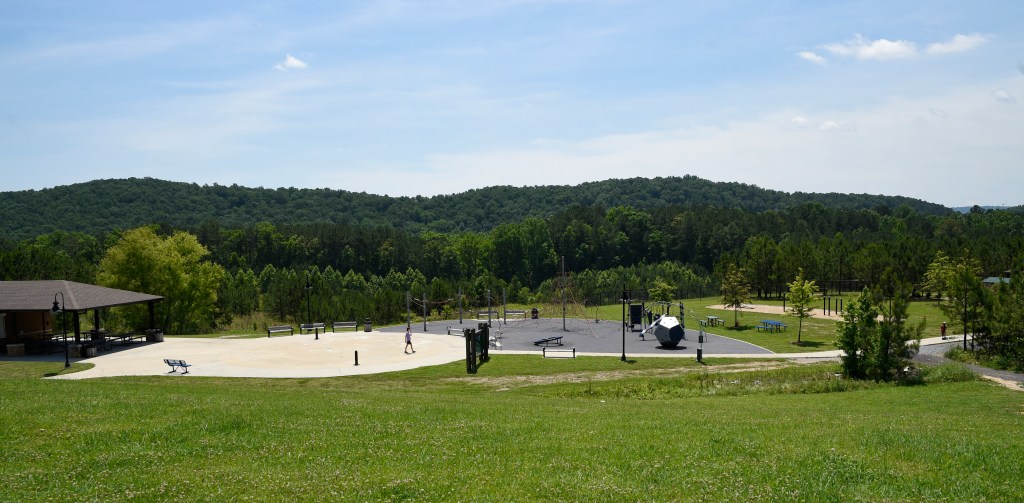
The trees that were planted after the reclamation in 2012 have now matured into a natural environment, Downes said. While reclaimed land can be turned into business or residential development, he said putting Sicard Hollow to lower-intensity use makes it easier to manage potential environmental risks like stormwater drainage and sediment runoff.
“There’s always a place for everything. And the more there is dense development, the more there is a challenge with managing environmental concerns,” Downes said.
Pine Ridge is accessible from the Sicard Hollow soccer fields, which made its 1,300-foot highwall a serious safety concern.
“You have a lot of kids coming to Sicard Hollow Athletic Complex to play soccer, and there’s little footpaths right behind the fields going to these old mines,” Morin said.
After the highwall is removed, however, that proximity becomes an asset, not a liability, Morin said.
“It’s in a great area to be developed into something else, but no one is going to develop it in its current condition,” he said.
Right now, there are no definite plans for what will be done with the Pine Ridge property. Downes said the city council has considered additional athletic fields, a police training facility or satellite library as “quality-of-life” improvements for nearby residents, “but as we sit here today, those are just visionary.”
Morin said the Pine Ridge reclamation is projected to cost around $3.6 million and should be complete this fall.
“Good projects always are the result of good relationships, and the ability for the city of Vestavia Hills and the Mine Reclamation office to achieve mutually beneficial goals from a project is something that is admirable, and we appreciate the partnership. We appreciate being allowed to pursue a vision of what might be,” Downes said.
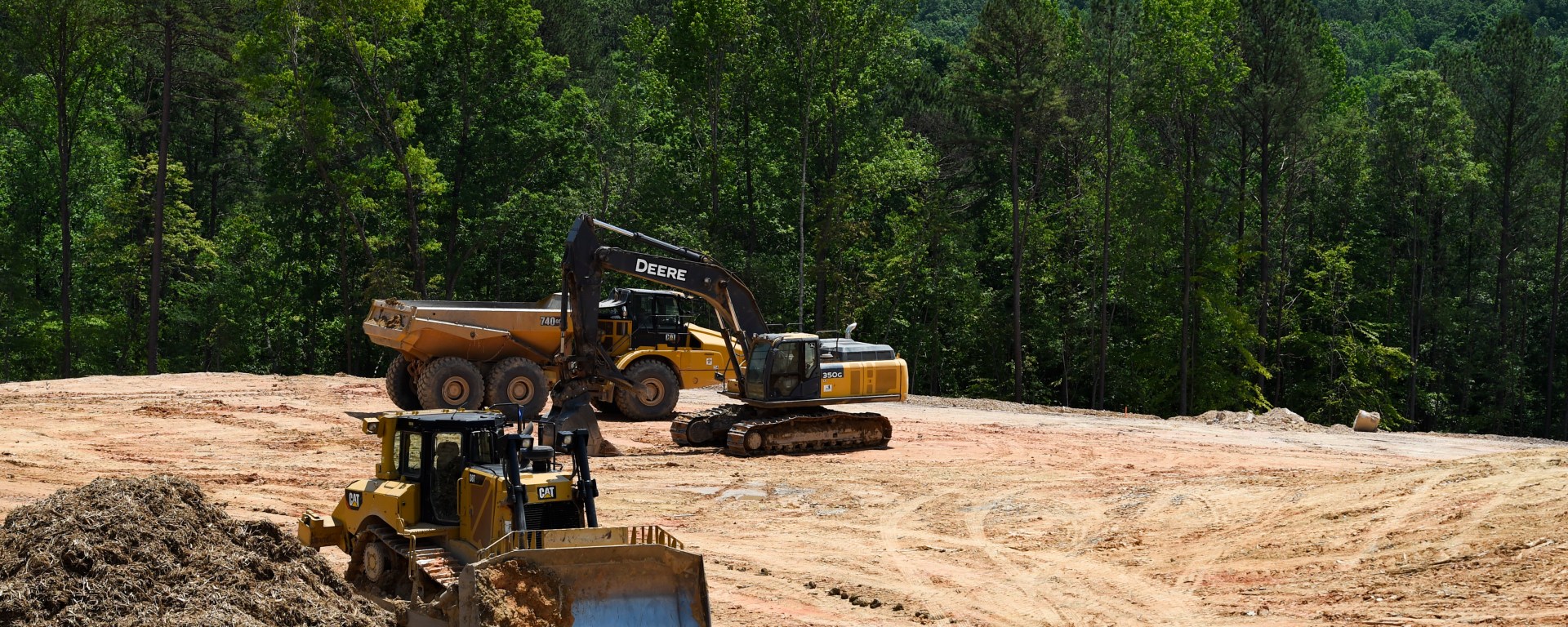
Main article image of construction at the Pine Ridge mine reclamation site by Erin Nelson Sweeney.
 Southern Science