

Months after Ala., Ga. governors’ agreement, questions remain on whether it will end ‘water wars’
by Sydney Cromwell
Water has been flowing down the Chattahoochee River from Georgia to Alabama to Florida for thousands of years. The three states have been fighting over how to use that water for nearly as long.
Alabama, Georgia and Florida have been at odds for more than three decades over how to balance the needs of agricultural, industrial, hydropower, recreational and residential users who draw water from the Apalachicola-Chattahoochee-Flint (ACF) basin’s reservoirs, as well as the ecological health of the rivers.
“It’s just a very touchy subject to have a river basin that’s subject to so many different kinds of uses up and down the system,” said Gil Rogers, the director of the Georgia office of the Southern Environmental Law Center (SELC).
In December, Alabama Governor Kay Ivey and Georgia Governor Brian Kemp unexpectedly announced a possible agreement between their two states over water use. It remains to be seen whether this agreement will be a solution to the so-called “water wars.”
“Any cooperation between the states, in theory, is a good thing, but we would just want to make sure the health of the river is put first,” Rogers said.
MANAGING A BASIN
Each state has a responsibility to protect the water interests of its own citizens and industries, but rivers are rarely polite enough to stop at the state line.
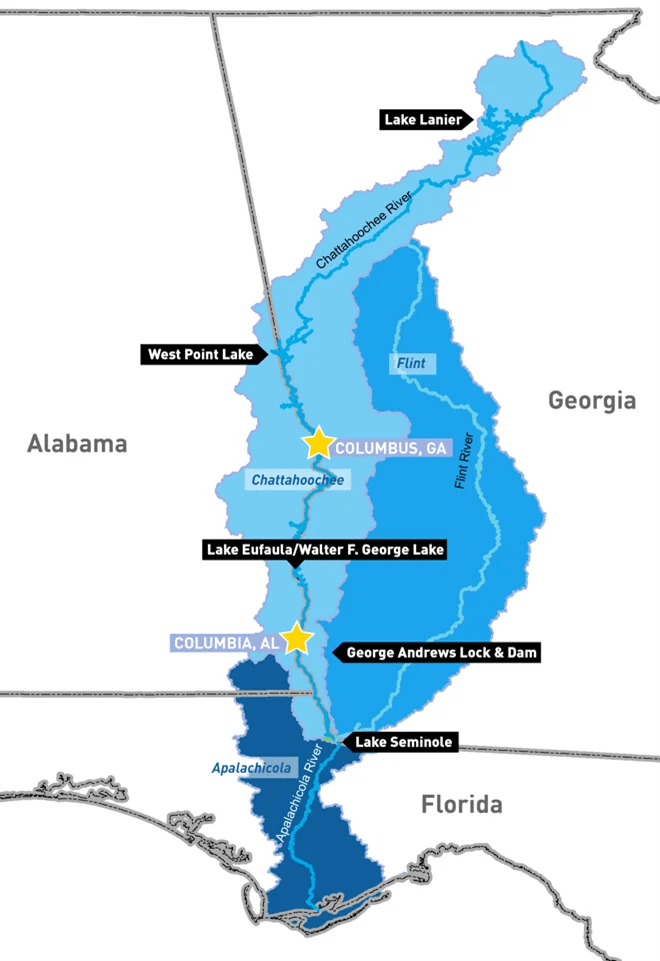
The three rivers of the ACF basin, for instance, collect water that drains from an area of more than 19,000 square miles from the northeast side of Georgia to the Florida Panhandle.
When a river system winds its way through multiple states, like the ACF, that can leave downstream users feeling shortchanged, especially when drought or demand put a heavy burden on the water supply.
The Southeast’s water supply, both above and below ground, is far more abundant than the sites of famous water-use battles like the Colorado River. And yet, the war between the three states over a fair distribution of the ACF’s waters has continued since 1990.
More than 5 million people depend on the Chattahoochee River for their water supply, according to the Chattahoochee Riverkeeper.
Alabama’s users who depend on the waters of the ACF include the Farley nuclear power plant, a paper mill in Columbus and recreational and other purposes on West Point Lake and Lake Eufaula.
Upstream, Lake Lanier provides drinking water for Atlanta residents and a thriving recreation industry. About 800,000 acres of Georgia farmland are also irrigated by the Chattahoochee River, according to the Riverkeeper.
Downstream, Florida is concerned about the amount of freshwater reaching Apalachicola Bay and how that affects industries like oyster fishing and tupelo honey.
Wastewater is also discharged into the rivers at various points, and minimum water levels are needed to dilute that waste and protect water quality. In July, the Riverkeeper and SELC threatened to sue Atlanta over a local plant’s repeated discharges of illegal levels of pollutants, including E. coli, into the Chattahoochee.
“The environment is usually last on the totem pole for water needs,” said Cindy Lowry of the Alabama Rivers Alliance (ARA).
The U.S. Army Corps of Engineers is responsible for managing water flow and reservoir storage throughout the ACF basin, using a water control manual that was last updated in 2017. Before that, the manual hadn’t been updated since 1958 — though the Corps’ 1989 attempt at updating the manual is what kicked off the water wars.
“There’s no real cooperative management happening now at all. It’s kind of every person for themselves.”
Gil Rogers, SELC
The sticking point throughout the conflict has been equitability: making sure each state’s users get what they feel is a fair portion of the river system’s waters, and that it’s enough to meet their needs.
“We just want to make sure that the river is healthy and that no state takes too much water out of it and no state puts too much pollution into it,” Rogers said.
Since the Alabama and Georgia governors announced their proposed agreement, environmental groups like the ARA and SELC have described themselves as cautiously optimistic about its future. But this agreement is far from the first time the states have attempted to reach equitability.
THE 30 YEARS’ WAR
In March 2000, the New York Times published an article about negotiations between Alabama, Georgia and Florida to create a long-term water management plan for the ACF. The article reported that “many see this week as the beginning of the end to the war” over the states’ water use.
Twenty-four years later, we can say with hindsight that it certainly was not the beginning of the end.
“There’s no real cooperative management happening now at all. It’s kind of every person for themselves,” Rogers said.
The water wars started with the Corps’ draft water control manual in 1989, which was meant to meet Atlanta’s drinking water needs with supply from Lake Lanier. Alabama filed suit in 1990 to stop the plan, and Georgia and Florida later joined the suit.
“This river has been tied up in litigation for decades,” Rogers said.
In 1992, the three states and the Corps agreed to suspend the suit and conduct a comprehensive study of the basin’s water resources, which was never completed.
In 1997, the federal government and the states established a commission to work out a water management agreement, according to the New York Times’ 2000 reporting, but the commission could never come to terms and dissolved in 2003.
After that, the states filed several more lawsuits over how the Corps manages its ACF reservoirs.
In 2010, Florida’s lawsuit alleging the Corps violated the Endangered Species Act was dismissed in federal court.
In 2011, a federal appeals court dismissed the three states’ cases over Corps operations at Lake Lanier. The states appealed that decision to the U.S. Supreme Court, which chose not to take up the case.
In 2013, Florida filed a suit against Georgia over how the water in the basin is apportioned between the states and its harm to the Florida fishing and oyster industry. The Supreme Court eventually dismissed the suit in 2018, stating that Florida failed to provide enough evidence that the water levels in the basin were to blame for the collapse of oyster fisheries in Apalachicola Bay.
The Supreme Court rejected another request by Florida, this time to limit the amount of water Georgia can withdraw from the basin, in 2021.
When the Army Corps of Engineers updated their control manual for the ACF reservoirs in 2017, Alabama responded with a challenge to the manual’s fairness, particularly the resources allocated for Atlanta’s drinking water supply. That case is still being litigated.
“That ruffled Alabama’s feathers, and Alabama filed a legal challenge against the Corps’ decision to basically allow more water to Georgia,” said Chris Manganiello, the Chattahoochee Riverkeeper water policy director.
‘AN ALTERNATIVE TO THE COURTROOM’
Not all of the attempts to resolve the water wars have been based on lawsuits.
In 2008, representatives from all three states created the ACF Stakeholders to meet and discuss equitable division of the water resources in the basin. The stakeholders included representatives from county and local governments, the various industries that use the river and environmental groups.
“The ACF Stakeholders was formed as an alternative to the courtroom,” Manganiello said.
The stakeholders presented their Sustainable Water Management Plan in 2015, which included recommendations on water storage in the basin’s reservoirs, drought management policies and a series of target flow levels at different points along the Chattahoochee to meet demand.
“The sustainable management plan kind of fell on deaf ears because the states weren’t interested in listening to or talking about it.”
Chris Manganiello, Chattahoochee Riverkeeper
In the plan, stakeholders also recommended a “transboundary” agency to manage water concerns in the basin across the three states. Rogers said the ACF basin needs management similar to how other multi-state water bodies, like the Great Lakes or the Delaware River, are handled.
“I think those recommendations are probably the best roadmap forward for management of the Chattahoochee,” Rogers said.
The 2015 plan also highlighted a need for more research into climate-related variability of the water supply, real-time flow information and better modeling of the river systems under varying management scenarios.
However, the stakeholders’ plan was released around the same time that the Supreme Court considered the lawsuit Florida filed against Georgia for the collapse of Apalachicola Bay’s fisheries.
“So, the sustainable management plan kind of fell on deaf ears because the states weren’t interested in listening to or talking about it,” Manganiello said.
“We were ready to go to the governor’s office and say, ‘Here, we the stakeholders think we have a better way of solving this,’” said Friends of Lake Eufaula President Brad Moore, who is part of the stakeholders group. “… And then every door closed to us.”
You can read the complete 2015 Sustainable Water Management Plan here.
Nearly a decade later, the ACF Stakeholders continue to meet and participate in drought planning for the basin. In spring 2023, Manganiello said, the stakeholders and representatives from the three states’ governments held a drought exercise on how to respond to different water shortage scenarios.
“That was the first time that had ever been done in the ACF river basin,” Manganiello said.
In the years since the COVID-19 pandemic, Moore said the stakeholders have been trying to get the governors’ offices interested in new discussions over the ACF basin.
“The primary goal was just trying to get the states to sit down,” Moore said.
Rogers said the difficulty of finding water management terms acceptable to all three states hasn’t given much political incentive to resolve the issue.
“It’s a hard system to manage generally, and then when you put politics on top of that,” he said. “… Georgia, Alabama and Florida have all had Republican governors now for over a decade, and they still can’t find a solution.”
A NEW AGREEMENT
It came as a surprise to water quality advocates when Ivey and Kemp announced their tentative agreement over the ACF basin in December.
“I was as floored as anybody when I heard that the two governors were talking about it,” Lowry said, though she added that she was “very happy” that it was happening. “… I don’t think that the courts are the way to solve this issue.”
The Office of Water Resources (OWR), part of the Alabama Department of Economic and Community Affairs (ADECA), negotiated on Alabama’s behalf to come up with the final proposal. Josh Carples, a spokesperson for ADECA, said the two states’ negotiations started at the Eleventh Circuit Court of Appeals.
“The court’s confidentiality rules associated with the mediation preclude us from speaking to the details of the mediation,” Carples said via email in June. “The mediation process, however, consisted of several meetings and sessions that occurred over the course of more than a year.”
“Are these metrics going to be the right metrics, particularly in the context of changing precipitation, drought, evaporation? Are these numbers going to be helpful for the resilience of the Chattahoochee River in the long run?”
Chris Manganiello, Chattahoochee Riverkeeper
Florida wasn’t involved in this negotiation since it wasn’t part of the suit that Alabama filed in 2017.
Southern Science reached out to both Ivey and Kemp’s offices about the proposed agreement. Kemp’s office did not respond to interview requests, and Ivey’s office deferred to the information provided by ADECA.
The agreement the states published would set targets for minimum water flow in two locations: Columbus, Ga., and Columbia, Ala. In Columbus, the minimum flow must be met on a rolling seven-day average, while in Columbia, the minimum must be met on weekdays.
“Because there have been increased water withdrawals upstream of Alabama in Georgia and there is a set flow regime in the Apalachicola River in Florida, the Alabama reach of the Chattahoochee would experience degraded flows without this agreement,” Carples said.
If reservoir storage levels are low enough to enter what the Corps considers the “drought zone,” these minimums must only be met two days per week.
“During droughts, these minimum flows will provide Alabama’s stakeholders with sufficient certainty so they can plan appropriately,” Carples said.
The agreement also asks the Corps to affirm its minimum water level on Lake Seminole, which releases water from the Chattahoochee and Flint Rivers into the Apalachicola River.
“We believe that adding these minimum flows makes affected Alabama stakeholders better off. This is not designed to affect certain users at the expense of others,” Carples said.
The Corps has agreed to review the proposed terms and decide whether to update its master water control manual to include these flow objectives.
Manganiello said it’s significant that the proposed flow levels in this agreement are similar to the metrics included in the ACF Stakeholders plan published in 2015.
“These proposals, they weren’t really pulled out of thin air, which is a little reassuring because these numbers, these metrics, have actually been in discussion since 2003,” Manganiello said. “… Different stakeholders at different times have proposed numbers that were very similar, not identical.”
Manganiello said he is hopeful but still wants to see more details about the agreement’s particulars and how it would be implemented.
WHAT’S NEXT
Since December, the proposed agreement between the two states has been in the hands of the U.S. Army Corps of Engineers for review.
The Corps also did not respond to Southern Science’s interview requests. However, their review process is likely to take about a year and include environmental study and a public comment period, based on discussion from the Atlanta Regional Commission.
“We’re kind of looking forward to the public process,” Manganiello said.
While fair division of the basin’s resources is the banner issue in the water wars, Manganiello said he also wants to make sure the proposed agreement does enough to protect the ecological health of the rivers. Wastewater discharge already causes water quality issues in the lower part of the ACF basin, he said, and the Riverkeeper has also documented algae blooms in its reservoirs, which can be caused by excess nutrients, such as agricultural runoff, entering the water.
“All of those things will factor into our evaluation,” Manganiello said.
It remains to be seen, he said, whether the proposed minimum flow standards will likely be sufficient to meet future needs as weather patterns and populations change in the basin.
Climate change is causing shifts in when and how rain falls in the ACF basin, Manganiello said, leading to droughts and floods that will need to be managed. Warmer nighttime temperatures, also an effect of climate change, mean more water evaporation. Both of these factors will impact how much water is available for use at any given time.
“Are these metrics going to be the right metrics, particularly in the context of changing precipitation, drought, evaporation? Are these numbers going to be helpful for the resilience of the Chattahoochee River in the long run?” Manganiello said.

The agreement will also need to consider future population growth in Atlanta and new commercial or agricultural users. Manganiello said Atlanta’s water consumption has plateaued, despite the city’s growth, due to water conservation and efficiency measures. However, he said it would be hard for the ACF basin to keep up with significant growth without major changes in the way people use water.
“When they’re looking in the future, they’re talking about needing more water,” Manganiello said. “… When you look at metro Atlanta, there’s a lot of great water efficiency on paper. It’s a lot harder to see what those policies look like in their implementation. And that’s unfortunately a global issue.”
While the Corps is reviewing the proposed agreement, Alabama has paused its lawsuit. The state will have to choose whether to continue its suit once the Corps announces its decision on the agreement.
However, if the proposed standards are made part of the Corps’ management of the ACF basin, it wouldn’t mean that the “water wars” have been totally solved. Since Florida wasn’t part of the negotiations with Alabama and Georgia, its concerns aren’t factored into the agreement.
Wildlife and water quality organizations in Florida have said they plan to continue appealing their case against the Corps and its handling of environmental concerns.
“Any settlement just between Georgia and Alabama will only go so far because Florida isn’t at the table,” Rogers said.
Rogers said he believes it’s possible to find a management regimen that can meet the demands placed on the ACF basin.
“If it’s managed properly, there ought to be a scenario where everybody gets the water they need and the system is healthy,” he said.
MORE AT STAKE
If Alabama and Georgia’s agreement can successfully resolve some of the water-use issues that have stoked the water wars since 1990, it will have impacts beyond the ACF basin itself.
The Alabama-Coosa-Tallapoosa (ACT) River basin, which also flows from Georgia to Alabama and is managed by the Corps, has been subject to the same history of litigation and negotiation over fair use as the ACF basin. An agreement on one waterway might pave the way to an agreement on the other, Lowry said.

Carples said the federal district court in Alabama’s ongoing ACT basin lawsuit, which challenges the Corps’ 2015 water control manual update and use of water supply at Allatoona Lake, has not yet ordered mediation.
“But Alabama hopes that the states can apply their momentum and cooperative approach from the ACF case to a resolution of their disagreements about the ACT. Alabama stands ready to commence discussions with Georgia about the ACT,” he said via email.
The ACT basin has a much larger impact on Alabama than the ACF basin, Lowry said, since it passes through more of the state before emptying into Mobile Bay. It also includes 11 Alabama Power-owned dams.
“Alabama has a lot more at stake in that system than the Chattahoochee,” Rogers said.
“If it’s managed properly, there ought to be a scenario where everybody gets the water they need and the system is healthy.”
Gil Rogers, SELC
When it comes to handling present and future water conflicts with neighboring states, water quality advocates say Alabama is handicapped by its lack of comprehensive water management policies. The OWR tracks self-reported use by consumers of more than 100,000 gallons per day, and it works with other state departments on drought and floodplain management.
However, groups like the Alabama Rivers Alliance have argued for more than a decade that the state needs a water management plan because it doesn’t have a detailed understanding of how the state’s water resources are being used, or how much is available.
By contrast, Georgia has a water plan with regular resource assessments and management practices specific to different regions of the state.
The Middle Chattahoochee Regional Water Planning Council is Georgia’s planning body that encompasses most of the ACF basin that’s shared with Alabama. Manganiello said members of the council have frequently commented on the difficulty of planning for Alabama.
“They never have a clear picture of Alabama’s needs,” Manganiello said. “… They’re planning it blind.”
When water-use issues make it to the courtroom, that user data can be critical. Florida had multiple lawsuits against Georgia dismissed because it couldn’t provide the data to back up its claims about water use.
“Georgia has developed a pretty robust suite of water laws, water regulations and policies that I don’t see in the neighboring states, and that ultimately puts Georgia in a better position in legal challenges,” Manganiello said. “… Those states would be benefited if they had more robust water planning policies.”
Rogers said that while all three states involved in the water wars could improve their water planning, “Alabama in particular has a long way to go in terms of regulating water withdrawals.”
Read more from Southern Science about Alabama’s water management policies.
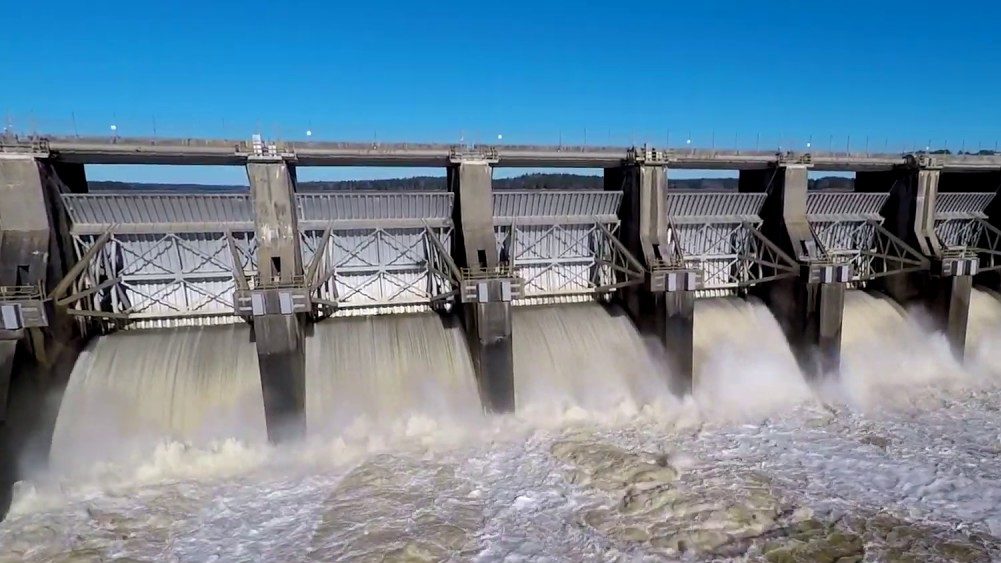
Main article image of the Chattahoochee River between Phenix City, Ala., and Columbus, Ga., by Ken Lund, via Wikimedia Commons.
 Southern Science
One thought on “Good rivers make good neighbors”