
UA digital seed bank helps preserve Choctaw heritage
by Sydney Cromwell
In the hands of the Choctaw nation, the seeds of plants like lambsquarter and sweet potato squash have been cultivated for hundreds of years. They traveled with the people from their historic homes in Alabama and Mississippi to Oklahoma during the forced relocation of the Trail of Tears, sometimes hidden in the hems of women’s clothes.
More recently, these seeds — a critical part of Choctaw food heritage — have been launched into space. And now, with the help of a research team at the University of Alabama, the seeds are entering cyberspace.
VIRTUAL REMNANTS
At the University of Alabama’s CONSERVE group, researchers are combining traditional academia with Native knowledge to create a digital seed bank, preserving information about the plant species that have been significant in Choctaw culture.
Several of the famous international seed banks around the world, such as the Svalbard Global Seed Vault in Norway and the Millennium Seed Bank in the United Kingdom, focus on saving physical specimens in case of natural disaster or crop failure.
However, Katie Chiou, CONSERVE’s assistant director of water social science, said their partners, the Choctaw Nation of Oklahoma, are already growing, saving and sharing the seeds from their heritage crops.
The role of the DIGISEED (Digital Identification and Geolocation of Indigenous Seeds, Ecosystems, and Environments Database) bank, instead, is to preserve and share something just as valuable: knowledge.
So far, CONSERVE has documented around 20 species in its seed bank, all provided by the Choctaw Nation, Chiou said. The seed bank can save microscope photographs of the seeds and details such as physical characteristics, the location where they were found and the tribe’s current and historical uses of these crops. They hope to add genetic information as well, she said.

“It’s appealing to us to have some of the seeds professionally documented,” said Ian Thompson, the Choctaw Nation of Oklahoma’s tribal historic preservation officer.
Some of the seeds are from plants the Choctaw have cultivated since before Europeans arrived in North America. Some have dwindled to only a few scattered remnants, found in archaeological sites, a single family’s garden or growing wild, Thompson said.
CONSERVE wants to maximize “any information we can get from these remnants,” Chiou said, to increase the chances of success in bringing them back.
The Choctaw Nation’s Growing Hope project shares its seeds with tribal members to encourage them to grow and eat traditional crops. They also track where the seeds were found and the best ways to grow them.
With members of the nation spread out over Oklahoma, Louisiana, Mississippi and elsewhere, Chiou said that a digital seed bank can serve as a centralized way to store and share that information, regardless of location. The seed bank also can help people identify unknown seeds that they find, she said.
The DIGISEED project has developed slowly over the past couple of years, and the database itself isn’t quite ready yet for the tribes’ use, Chiou said.
The CONSERVE team has also built a learning garden at the University of Alabama’s arboretum to grow around six of the species in the seed bank and return a new generation of seeds back to Growing Hope in Oklahoma, she said.
The knowledge stored in the digital bank, Thompson said, will help the Choctaw Nation’s efforts to protect the health and food security of its members, especially as changing climate conditions continue to influence agriculture.
A BRIEF HISTORY OF THE CHOCTAW DIET
Several of the species preserved in the digital seed bank have names that would be familiar on a modern American grocery list: corn, peas, squash, sunflower seeds.
However, the plants themselves are much different from their counterparts that are farmed as monocultures and delivered to the produce aisle. Choctaw flour corn (tanchi tohbi), for instance, grows taller but has fewer ears than sweet corn. Lambsquarter (tvnishi, used as a green similar to spinach) and sweet potato squash (isito) are both higher in vitamins than their grocery store relatives
“They’ve really been replaced, or are pretty much replaced,” CONSERVE researcher Leah Mungai said. “… These are almost like the forgotten crops.”
That loss of genetic biodiversity means agriculture is more susceptible to disease, pests and changing weather conditions, Chiou said.
“We live in a society where things are so reduced. We have so many monocultures,” she said. “… They are easily gone.”
“We’re trying to salvage what it is that still exists.”
Katie Chiou, CONSERVE
In the same way that sweet corn or butternut squash have been bred and modified over decades to thrive in large-scale agriculture and satisfy consumer tastes, Thompson said, Choctaw crops are also the result of generations of careful selection.
Choctaw farmers chose and adapted plants that could withstand harsh winters or long droughts, depending on their environments, he said, which created many varieties even within a single type of corn. The Choctaw obtained some species, like winter squash and beans, through trade with other tribal groups from the Southwest and Mexico, he said.
While lambsquarter was a species that Choctaw people gathered from the wild in the Southeast, Thompson said, they actually learned to cultivate it from tribes to their north.
Chiou, who is an archaeologist by training and an assistant professor of anthropology, said it’s possible to trace some of the Choctaw’s dietary habits back for thousands of years. Archaeological sites like Moundville often have seeds that were left behind and preserved, she said, although the food picture is incomplete — other foods, like tubers, would have rotted and disappeared from the historical record.
“We’re heavily reliant on seeds, which heavily biases the data,” Chiou said.
Chiou said the data they’re gathering for the DIGISEED bank may eventually be able to shed more light on Native groups’ diets in the distant past.
“Connecting people also to deep time would be really interesting,” she said.
Flour corn, used to make bread, has been in the Choctaw historical record since at least the 1700s, Thompson said, and is made distinctive by the height of its 20-foot stalks. Other crops aren’t as easy to trace back when the historical descriptions aren’t specific, like the bean species that Thompson has collected from tribal elders.
“The old descriptions are [that] Choctaws grew every type of bean imaginable,” he said.
The Choctaw took many of their crops with them as seeds when they were forced to relocate to Oklahoma in the 1830s. However, there they had to adapt their farming to a very different landscape, Thompson said.
Some species couldn’t survive if the Choctaw planted and tended them the same way they had done in Alabama, Thompson said. This was an experience he and the Growing Hope program would reencounter when they planted flour corn for the first time, using old accounts of when to plant. The entire crop was “obliterated” by the Oklahoma summer, he said.

The Choctaw historically also had to contend with disease, poverty, cultural assimilation, loss of tribal elders and efforts by the U.S. government to separate them from the knowledge of their own traditions, language and ways of life for decades.
“For a long time, there was this loss of ties to certain kinds of identities,” Chiou said.
In this environment, much of the Choctaw Nation’s understanding of its past agriculture and diet nearly or completely disappeared, as did some of the species.
“We’re trying to salvage what it is that still exists,” Chiou said.
Some of the plants cultivated by Growing Hope and stored in the seed bank today were found by luck or years of diligent searching to come up with a handful of remnant seeds, Thompson said.
For instance, bottle gourds were found during archaeological preparation for road work near a Choctaw agency site that dates back to the 1800s, he said, probably on the site of the post’s garden. He looked for flint corn, used to make hominy, for a decade before finding a seed saver last year who still had some viable seeds.
“It’ll be a while before we get to taste that one, but to have it back and thriving is good,” Thompson said of the flint corn.
When they’re only able to find a handful of remaining seeds, it takes multiple seasons of careful cultivation and seed storage before they have enough to share, he said.
“That’s more value than gold by weight. So much work in such a small material,” Thompson said.
References to other crops, like the tanchusi variety of corn, are found in historical records, he said, but living plants or viable seeds have never been found again.
“Maybe we’ll find it someday,” Thompson said of tanchusi. “Unfortunately, we don’t even have a good description of what it looked like, which makes that less likely.”
But with the generational knowledge and heritage species that they have been able to recover, he said, Growing Hope is trying to reintroduce the advantages of historical diets to the present-day Choctaw way of life.
HEALTH AND FOOD SECURITY
Thompson’s return to a traditional diet began not at an archaeological dig, but at a doctor’s office. When his wife was diagnosed with Type 2 diabetes, Thompson said they decided to try to change their lifestyle before treating the disease with medication.
Thompson had grown up working his grandparents’ garden, which included a heritage variety of field pea that his family had brought from Mississippi and continued to cultivate for 140 years, and his role as tribal historic preservation officer had already introduced him to some of the traditional crops of the tribe.
The couple had a garden of indigenous foods and a small herd of bison, but they decided to expand both and also cut all processed foods from their diets. Within a matter of months, Thompson said, his wife was no longer in the diabetic blood sugar range and they had lost a combined 70 pounds.
“A lot of the traditional types of corn have much better nutritional value than modern varieties do,” Thompson said. “Our community suffers quite a bit from diabetes, so our traditional corn is better for working to recover than sweet corn is.”
Type 2 diabetes is nearly three times more common among Native Americans than among white Americans, according to the Centers for Disease Control. Obesity, heart disease and high blood pressure are also more common among Native populations, which have an average life expectancy more than five years shorter than the U.S. average, according to the federal Indian Health Service.
Thompson started reaching out to seed savers and others in the Choctaw community who might have remnants of some of these former crops. The tribe got a grant to build a greenhouse and add staff.
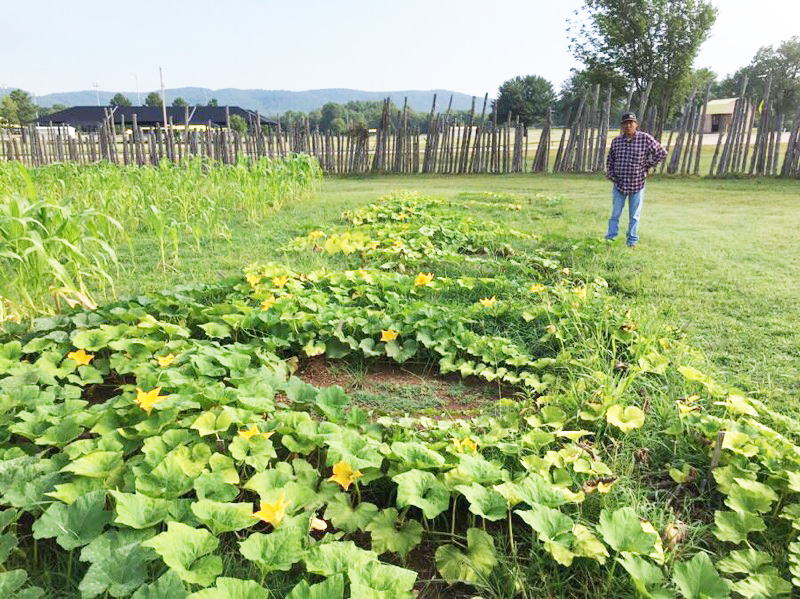
In 2015, the Choctaw Nation launched Growing Hope to share traditional food crops with other tribal members, in hopes of seeing the same benefits to their health and reconnection to their culture.
The program now shares seven different species with the tribe, while other species are being grown to share in the future. Last year, Growing Hope gave out seeds to around 3,000 community members who applied to receive them, Thompson said.
Along the way, they have relearned much about how these heritage species are best farmed. After the first crop of white corn failed due to summer conditions, Thompson said they learned from an experienced gardener and planted their second crop earlier, so the corn could get established before the most intense parts of summer.
Growing Hope has built raised beds to deal with flooding and sun shades to protect its more heat-sensitive plants, Thompson said. Some species are also started in the greenhouse, so they can mature faster.
Testing these different plant varieties and growing methods can also lead to more climate-resilient agriculture, Mungai said. Certain species may be better equipped to handle drought and heat without needing extensive irrigation.
“These crops are really security. It’s food security, but it’s also security with this really erratic weather system that we have right now,” she said. “… Farmers will tell you they’ve noticed the timing of rains, that they’re delayed or they come early, and that affects planting.”
RESTORATION OF A WAY OF LIFE
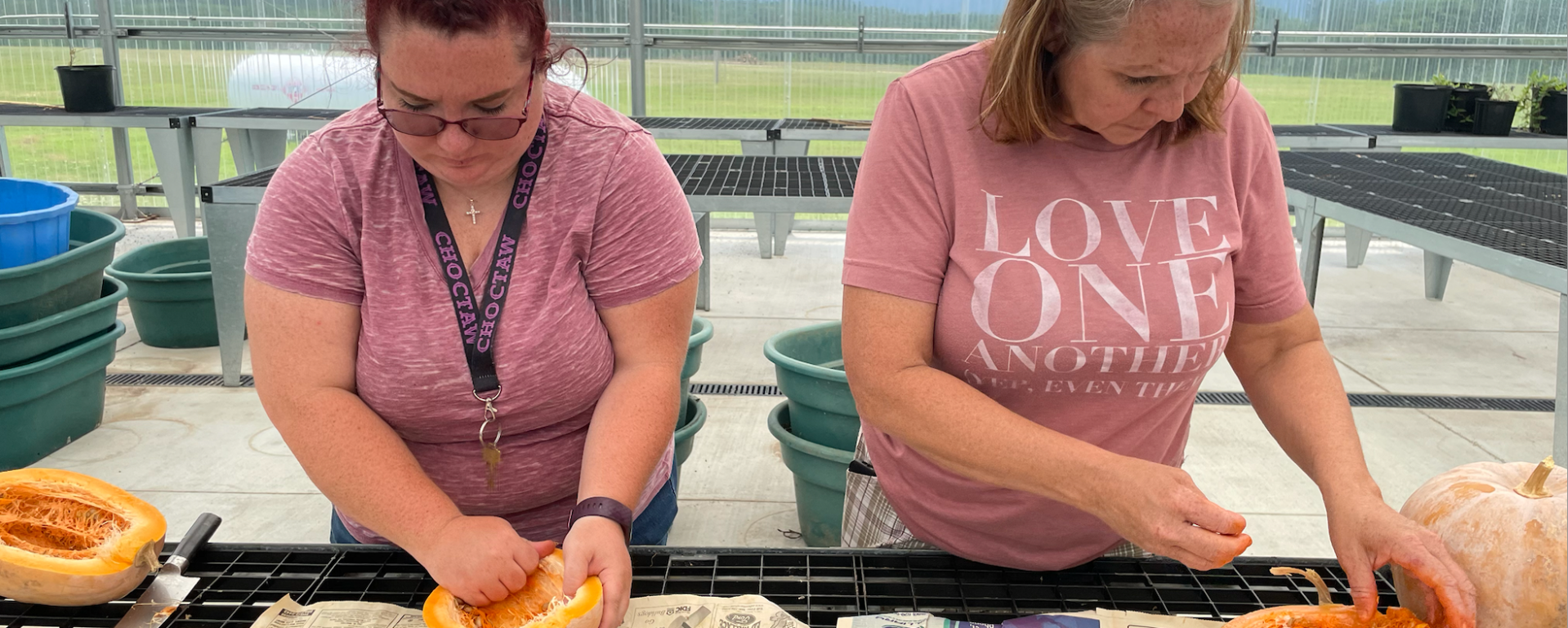
Growing Hope doesn’t just provide the seeds; it also conducts workshops and demonstrations to teach people how to grow the crops and cook with their harvest.
“If you can get those folks involved in cooking with that food, they’ll be a lot more interested in trying that dish,” Thompson said. “… That’s where the health benefits come in.”
The Choctaw reservation’s cultural center now serves sweet potato squash as a regular part of its menu. Thompson said growing and eating traditional foods dovetails nicely with tribal members’ growing interest in learning about other areas of traditional Choctaw life, like pottery, landscape management and language.
“One aspect of cultural revitalization revives another,” he said.

Seeds of their squash, flour corn, lambsquarter and two varieties of peas were even sent to the International Space Station for six months through a partnership with NASA, Thompson said. Students at one of the Choctaw Nation’s schools will be planting those seeds alongside earthbound ones, to see how the radiation from space affects their growth.
“The important part of this is to get native kids interested in STEM and also in traditional agriculture,” he said.
Chiou and other researchers from CONSERVE first visited the Growing Hope program around three years ago, while they were working on building the seed bank partnership. While there, they got to taste some of the dishes made from these crops, Chiou said, which made the value of agricultural diversity — and, in particular, saving culturally significant species — all the more real to them.
“From just a culinary perspective, there’s so much potential for these foods to come back,” she said.
“The idea is to build a place where wisdom can be cultivated and shared. And it’s not our wisdom, we’re just building the infrastructure.”
John Burgess, CONSERVE
CONSERVE researcher John Burgess recalled watching people relearn traditional farming methods and the cultural stories about how these particular foods came to be part of Choctaw life.
“It’s astonishing what it can be like when you remember who you are,” Burgess said. “… In a very small way, we’re contributing to that broader project.”
When Mungai visited the Growing Hope gardens for the first time two years ago, she said it was a pleasant surprise to see rows of crops very much like the ones she knew from gardens in her home country, Kenya. Though she had never seen corn quite as tall as Choctaw flour corn, Mungai said she liked having “the ability to be familiar with crops that I know but in my own language.”
SHARING ECONOMY
DIGISEED, like much of the work at CONSERVE and the Alabama Water Institute, draws researchers from multiple areas of academia.
As an anthropologist, Chiou has studied humans’ relationships to plants in the distant past, but she wanted to turn her skills to a project that was “more useful for modern-day issues.”
Mungai joined the seed bank project as a postdoctoral student of geography, and her particular interest was in farming and food systems. Now an assistant professor, Mungai is creating story maps for the DIGISEED project to show how Choctaw culture relates to its location.
“It’s more like space and place,” Mungai said. “How do we tell a story about a culture, but a forgotten culture?”

Burgess is an assistant professor of library and information studies who often teaches about the role of libraries and archives as protectors and providers of knowledge to the public. A library, much like a seed bank, is part of a larger “sharing economy” with those who use and contribute to it, he said.
“Not everyone needs to own a copy of everything. It’s OK for us to share the things that we want and the things that we need,” he said.
Alongside the seed bank work, the DIGISEED project has provided Growing Hope with designs for seed packets and posters, Burgess said.
Chiou said the seed bank project has moved forward rather slowly, and that’s by design. At each step of the process, they want to make sure that DIGISEED is serving the needs of their tribal partners, not just their own research interests, she said.
“We had no plans for exactly what we were going to do. A lot of this has been emerging naturally as we meet people and find out what we can bring to the table,” Chiou said.
TRUST AND OWNERSHIP
While CONSERVE is building and facilitating the digital seed bank, Chiou said a key part of the project is that, unlike typical academic research, “the knowledge isn’t principally controlled by us.” The Choctaw Nation makes the decisions on what data is added to the bank, who it’s shared with and how it’s used.
The partnership has required both the research team and the Choctaw Nation to step a little outside their comfort zones. For the CONSERVE team, Chiou said, they have to get “comfortable with not being in control” and letting their partners be in “the driver’s seat.” For the Choctaw, as for many other Native tribes, there’s a long history of exploitation by universities and researchers that stands in the way of trust.
“Maybe more than half the battle has just been establishing trust,” Chiou said.
The Choctaw Nation already had an existing relationship with CONSERVE’s director, Mike Fedoroff, which helped pave the way for the DIGISEED project. Still, it took three years just to get to an agreement on how the seed bank would be created and managed.
Universities and museums across the country have taken and displayed Native artifacts and even human remains without permission for decades. Among them were the University of Alabama’s Museums, which collected more than 13,000 Native items and remains from Moundville and other archaeological sites in Alabama.
The UA Museums took some of their artifacts off display and began repatriation work in 2022, in response to years of pressure from Native groups. The most recent repatriation occurred in April 2024, but the museums still possess thousands of these items.
“Many things over the years have been appropriated from Choctaw culture,” Thompson said. “… We want to make sure that we don’t put these plants, which are sacred to many people, in a position to be exploited.”
Chiou said she sees DIGISEED as “one way that University of Alabama could be contributing to positive outcomes for tribes that have historically felt that the institution has been adversarial or not in their best interest.”
“It’s very symbolically resonant,” Burgess agreed, “… fulfilling a debt that we’ll never be able to fully repay.”
“We want to make sure that we don’t put these plants, which are sacred to many people, in a position to be exploited.”
Ian Thompson, Growing Hope
Being an academic is often about proving your superior expertise in your field as part of a “reputation economy,” Burgess said. It can be “unsettling,” he said, to set that goal aside.
“What we’re doing now is building a relationship economy instead, and one where it’s actually detrimental if we try to set ourselves on top of the mountain, peering down at people,” he said.
“I feel like I had to forget everything I knew and just be receptive to information coming in,” Chiou said. It was both a fulfilling and a humbling experience for her.
Doing this type of slower, community-directed research also means that what their partners want doesn’t necessarily line up with what a grant opportunity will fund or with traditional signs of research success, like published papers, Chiou said.
It can be difficult to have a foot in each world, she said, and to meet everyone’s expectations.
“We have to have the opportunity to mess things up and to fix things,” Chiou said.
There is a “universe of possibilities” for how the seed bank can be used, Thompson said, “as long as the tribe is in control of the data.”
PLANTING A SEED
At the moment, the DIGISEED team is still tackling the challenges of giving people access to contribute to and use the seed bank data, while retaining the tribe’s control over that access, Chiou said.
“For us, this is a very complicated issue that is going to require a lot of discussion,” she said. “… We’re not at the stage yet where it’s fully functional.”
Once they have that system in place, Chiou said, they’d like to use it as a proof of concept, so they can scale up the DIGISEED project with tribal partners across the United States, including other groups with ancestral roots in Alabama.
“The goal isn’t just to accrue information about the seeds and the practices,” Burgess said. “… The idea is to build a place where wisdom can be cultivated and shared. And it’s not our wisdom, we’re just building the infrastructure.”
Another possibility, Chiou said, is studying plant genomes to try to revive extinct species that are currently only found in archaeological remnants. Thompson said Growing Hope is working with their tribal geneticist on ways to extract embryos from seed specimens that are too old to be viable anymore.
“There’s the potential for it to become something more,” Chiou said.
With the trust they’re developing through the seed bank project, she hopes that CONSERVE and the Choctaw Nation can extend their collaboration to fulfill other needs, from CONSERVE’s rivercane restoration project to solving soil issues on the Choctaw reservation.
“Because we have developed this foundation of trust, we now have the potential to bring in other people,” Chiou said.
Main article image courtesy of Ian Thompson.
 Southern Science
fantastic
LikeLike