
Amid climate change, ‘dismalites’ keep on glowing
by Sydney Cromwell
Within the walls of Dismals Canyon, a tiny fly larva called the “dismalite” has been glowing for thousands of years. According to retired Auburn University entomologist Gary Mullen, they’ll likely keep glowing for thousands more.
While the world hits heat record after heat record due to climate change, Dismals Canyon, located in Franklin County, is unusually able to keep its resident dismalites protected from the worst impacts of a warming planet, Mullen said.
“Someone couldn’t have come up with a better location, but that’s why it’s so unique,” he said.
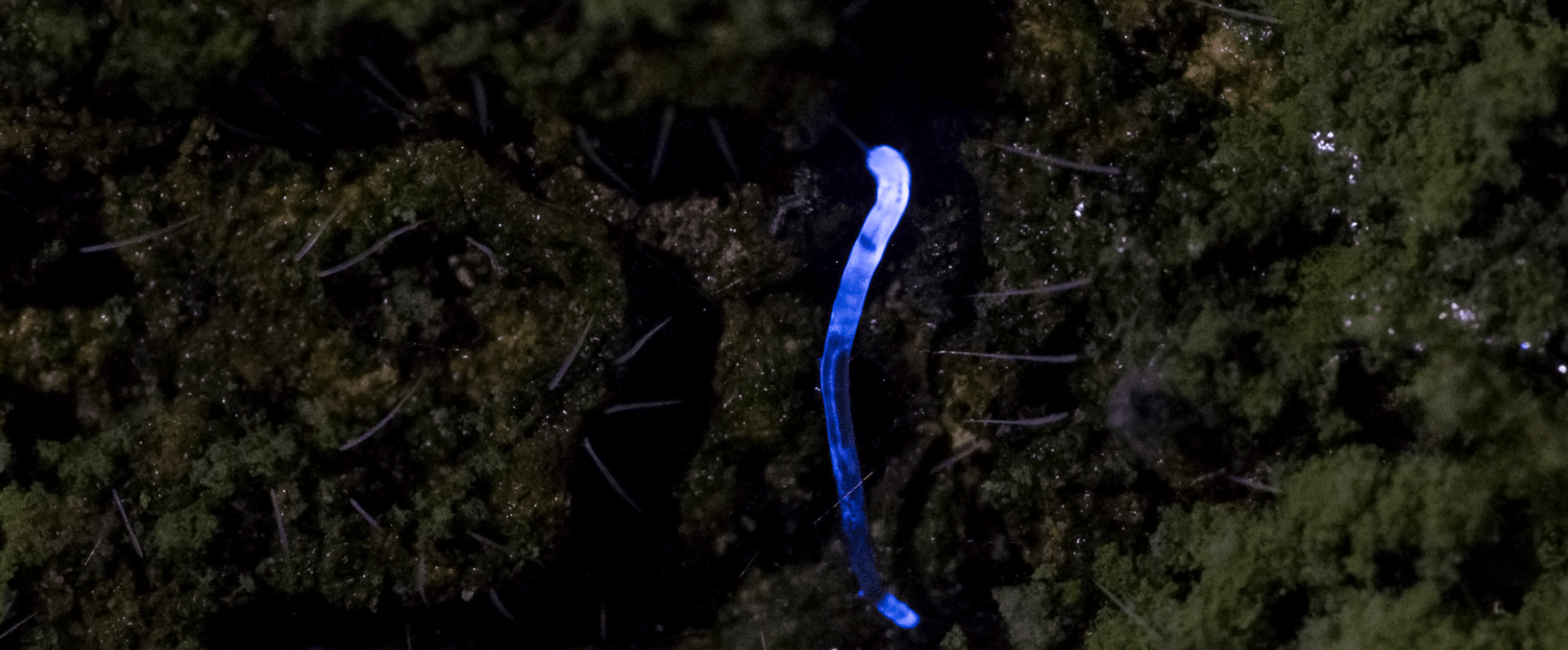
The dismalite is the larval form of a fly called Orfelia fultoni, and it measures less than an inch long. The larvae create their own luminescence to attract gnats, midges and other small insects, which get trapped in a sticky web and eaten.
The six- to nine-month larval stage is the longest portion of Orfelia fultoni’s life. Once it reaches adulthood, it will not eat again and only lives long enough to reproduce.
The chemical reaction that creates their light is similar to the luminescence of fireflies, but the dismalites’ light is the bluest of any insect that has been studied. When the larvae are at their peak activity, the walls of the canyon at night appear to be full of starlight.

Dismalites need consistently cool, moist places with very little wind in order to survive to adulthood, Mullen said. While they live throughout the Appalachian Mountains in states including Alabama, Georgia, North Carolina, Tennessee and Virginia, Dismals Canyon is home to the largest known population. The canyon, which is a National Natural Landmark but is privately owned, is open from spring through fall to tourists who come to see the tiny insects glow by the thousands.
“It’s not that the species is rare, it’s just that normally they would occur in small, scattered locations, … but here is just the ideal location,” Mullen said.
Dismals Canyon provides the cool, moist environment that dismalites need, and other rare life forms like the hellbender salamander and the eastern hemlock tree are among the hundreds of plant and animal species that also call the area home. Mullen said the distinctive conditions within the canyon were created during the last ice age, more than 10,000 years ago.
As the earth cooled and glaciers expanded southward during the ice age, Mullen said, creatures from much cooler northern climates traveled into southern regions they could now inhabit — including Orfelia fultoni.
When the glaciers began receding at the end of the ice age, they carved out Dismals Canyon and left small pockets of those northern life forms behind in places where the environment could continue to sustain them, Mullen said. The dismalites in the canyon today come from that remnant population, he said.
“It would not have survived here if it had not found this location,” Mullen said.
Dismalites can’t withstand the warmth of Alabama’s ambient temperatures, he said, but within the deep crevices and fissures of the canyon, they’re “largely protected from the extremes of temperature, humidity, wind.” The temperature inside the canyon during the summer averages about 14 degrees cooler than the temperature outside it, he said.
“That’s the real wonder of Dismals Canyon,” Mullen said.
The geography of the canyon creates a “cavern-like environment,” he said, where conditions tend to be fairly stable year round. He said the living conditions are almost like a laboratory, where temperature and other factors are tightly controlled.
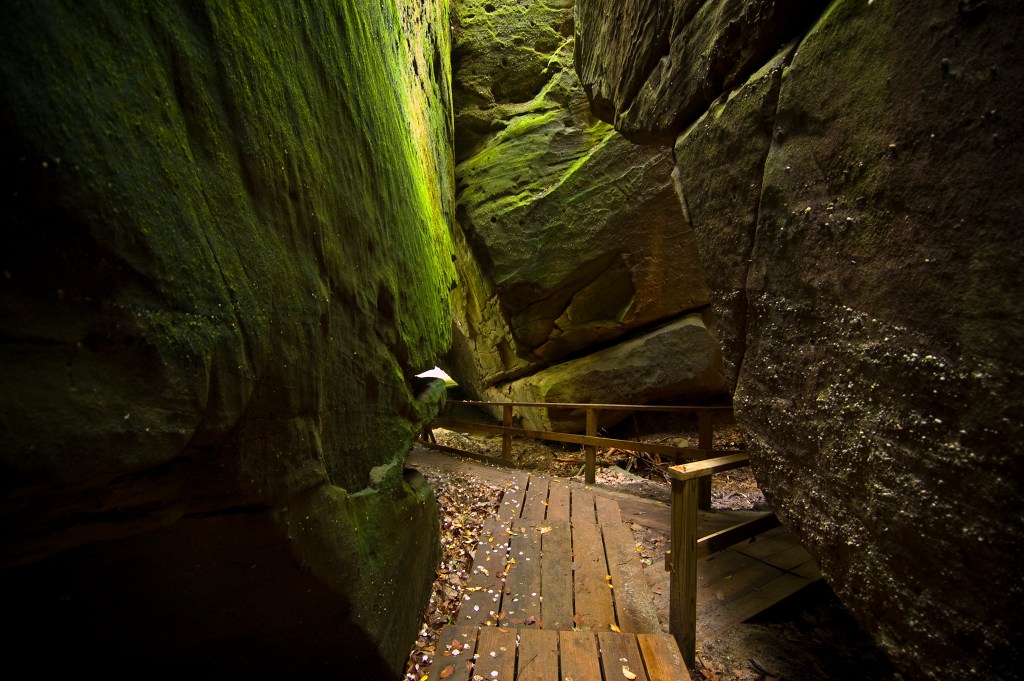

“It’s that unique, cave-like situation that explains it. Hot, cold is buffered,” he said. “… Life forms that occur in canyons and caves and so forth, they hardly change over time; they’re some of the most unique and bizarre species.”
The sheltering sandstone and limestone walls also keep moisture and humidity inside the canyon, even during extended droughts, Mullen said. During heavy rainfall, the dismalites climb the walls to stay above the water level, he said, but the water doesn’t get trapped in the canyon long enough to endanger their survival.
“They’re there year after year after year, but they’re high enough on these cliff faces so that [they survive] rushing water — or even dry spells, this would be one of the last places to dry out,” he said.
That means the dismalites can withstand variations in rainfall, humidity and drought seasons that are common side effects of climate change.
Insect population decline is another global source of alarm, though not all of the decline’s causes are linked to climate change. Some areas of the world have reported losses of as much as three-quarters of their insect population by mass. But Mullen said he isn’t seeing that kind of loss among the tiny bugs that make up the dismalite diet, so food sources don’t seem to be a problem at the moment.
“There’s plenty of things [to eat] because that’s a very vibrant canyon,” he said.

That’s not to say that the glowing larvae are impervious to the conditions of the world around them. Since he first began studying the dismalites in 1995, Mullen said their populations have changed from year to year. Their hatch dates in the spring and fall can shift by as much as a month, he said, if unusually cold temperatures slow their development or warmth speeds them up.
But that ability to speed or slow their development until conditions are right make the dismalites fairly resilient, Mullen said.
“One thing you can say about them is they’re survivalists,” he said. “… I don’t think that you could probably find an organism that is more adapted and protected from climate change.”
Climate change might shift when the larvae emerge each year, he said. It could also harm other populations of Orfelia fultoni that don’t live in an area as protected as Dismals Canyon. However, within the walls of the canyon, the heat and weather disruptions of climate change will likely be so muted that they won’t stop the dismalites from putting on their annual starlight show.
“They have survived there for these tens of thousands of years, so our climate change now is not so significant that it will affect them,” Mullen said. “… There’s no evidence that it’s affecting or could affect their population any time soon.”
That puts dismalites in a rare class of creatures.
“They may be about the last group of organisms in Alabama, really in the Southeast, that would be affected by the climate change we’re talking about,” Mullen said. “… They have all the ingredients they need to survive for many millennia.”
Main article image courtesy of Sunguramy Photography, via iNaturalist.
 Southern Science