
Samford professor explores how religious faith shapes trust in science
by Sydney Cromwell
Samford University professor Josh Reeves says he grew up in an “information bubble.”
Inside the bubble were his family, his church and their deeply conservative Presbyterian beliefs, Reeves said. Outside the bubble was everything his faith taught him to be skeptical of, including “secular” science.
“We never really engaged with the thinkers outside, but we had these caricatures” of them, Reeves said.
The years-long process of expanding his information bubble and challenging those caricatures didn’t just reshape Reeves’s opinions on scientific learning; it also would set the tone for his academic and professional career.
Reeves is now the director of Samford’s Center for Science and Religion. Since he was a graduate student, Reeves’s research focus has been on the tangled relationship between religious faith and trust in scientific knowledge.
Through a grant from the Templeton Religion Trust, Reeves and fellow researchers in Europe are studying how scientific truth can break through when faith has created a bubble of misinformation.
STUDYING SKEPTICS
Reeves and his fellow researchers want to understand what draws certain people toward misinformation and away from trusting established authorities. He said they want to consider the question from psychological, philosophical and religious viewpoints.
“There’s no one-size-fits-all answer for why some people are drawn in and other people are not drawn in,” Reeves said.
His partners on the research are Jonathan Jong, a psychologist and Anglican priest from Coventry University in Britain, and Jeroen de Ridder, a philosopher at Vrije University Amsterdam in the Netherlands. Templeton awarded them $160,000 in 2023 for a three-year study.
Reeves said their plan is to organize online conferences with groups of psychologists, philosophers and theologians from around the world to ask them questions about trust and what it means for different people. The first conference will be in April, he said.
“I feel like I am trying to give people resources about how we think about thinking.”
Josh Reeves, Samford University
These conferences will be the foundation of a book made up of the various experts’ perspectives on religious skepticism of science and trust-building solutions, Reeves said.
Reeves said he views this as the “generating questions” portion of the grant, and he’s hoping to apply for additional funding later to look further into those questions.
Aside from his work with the Templeton grant, Reeves said he’s also working on a book about conspiracy theories and Christianity. He said he wants the book to give people good guidelines for evaluating the truth of theories that they come across.
“I feel like I am trying to give people resources about how we think about thinking,” he said.
‘JUST ME AND MY BIBLE’
There are many psychological reasons why someone might not trust scientific knowledge, Reeves said, like a distrust of institutions, rigid personal beliefs, overconfidence in one’s own knowledge or a lack of understanding about the scientific process.
Those thought patterns aren’t always tied to a particular theology, Reeves said. But faith is central to many people’s lives and has a shaping influence over how believers see the world.
The overwhelming scientific consensus is that climate change is happening, and that it’s due to emissions and other effects of human activity.
However, in 2022, Pew research found that evangelical Protestants were the least likely of any American religious group to express concern about climate change, and they were the most skeptical about it being caused by human activity. Non-Christian religious groups, non-religious people and historically Black Protestant denominations were the most concerned about climate change, followed by Catholics and mainline Protestants.
The Public Religion Research Institute also found in 2023 that white evangelical Protestants and Latter-Day Saints were the least likely to believe climate change is caused by human activity. Hispanic Catholics, non-religious people and followers of non-Christian faiths were the most likely to attribute climate change to human causes.
Reeves said evangelical Protestant theology tends to encourage believers to trust in their own reading and understanding of the Bible, instead of a uniform theology handed down by a larger church establishment, Reeves said.
“I think Protestant Christianity tends to be very skeptical of institutions,” he said, and that feeling extends to scientific institutions as well.
“If you have a very individualistic type of Christianity, where it’s just me and my Bible and that’s all I need to understand what the world is like, that makes it very hard to trust people who are perceived to be secular,” Reeves said.
Cornell researchers found last year that biblical literalist Protestants tended to be indifferent toward climate change, while biblical literalist Catholics tended to be more concerned about climate change.
Rev. Rachel VanKirk Mathews, a pastor in the Presbyterian Church (USA) and assistant director of the Living River Retreat in Montevallo, said biblical literalists are often reluctant to engage with information that challenges a “black-and-white” interpretation of the Bible’s teachings. Questioning that understanding can feel like the start of a slippery slope, one that could lead to a complete loss of the stability that faith provides, she said.
“Then faith starts to become more of a mystery and less of a known entity, and that I think is scary for people,” Mathews said. That leads to feeling forced to choose which information source to trust, she said, and some people feel they have to “compartmentalize different parts of worldly existence away from their faith.”
“We do feel like it is a spiritual thing to care for the creation that we were given and try to repair the damage that we’ve done to it.”
Jenny Thagard, Living River Retreat
Mathews also said the process of scientific research can be unclear to outsiders, especially when news headlines tout a constant stream of research results that sometimes contradict each other.
“I think people start to doubt whether scientists really know what they’re talking about. If we invest in this solution and then it turns out it wasn’t the answer, I think people are afraid of being wrong or supporting something that fails,” she said.
Personal experiences, like a medical misdiagnosis or buying into a green energy solution that doesn’t live up to its hype, can also cement that skepticism in people’s minds, she said.
“Science can feel like it’s intertwined with money,” Mathews said, which leads some people to question: “Is it really for my benefit?”
FAITHFUL STEWARDSHIP
Though particular branches of faith have a higher likelihood of scientific mistrust, that mindset is far from universal even among similar believers.
Despite evangelical Protestants being the most likely to doubt climate change, Pew found that roughly a third of evangelicals they surveyed were seriously concerned about climate change’s effects. A different Pew survey from 2021 found less than half of U.S. Christians felt their religious beliefs “often” or “sometimes” conflicted with science.
Mathews said her denomination of Presbyterianism embraces scientific discovery, including in more religiously controversial areas like evolution and climate change.
“Human progression and human understanding are ways that we can legitimately learn more about God’s character and God’s design,” she said.
Science and faith are both integrated into her daily life, Mathews said, and she’s never felt like they conflicted.
Jenny Thagard, who works with Mathews at Living River Retreat and is also part of the Presbyterian Church (USA), has the same outlook.
“It doesn’t challenge my faith. Speaking for myself, I’m OK to let God be God, and I don’t have to make excuses or explanations for God,” Thagard said. “… There’s not a conflict for us. We can be both faithful believers as well as believing that this scientific research is true.”
Some churches have made the concept of “creation care,” or environmental stewardship, an official part of their theology, including the Episcopal church that Reeves attends. Several national religious groups have called for their followers to address climate change and take care of the environment, as has Pope Francis.
“Humans were charged to be good stewards of it. We recognize that the health of humans and the health of the Earth are very much intertwined,” Mathews said.
According to the PRRI study from 2023, roughly 58% of surveyed Americans considered a God-given role of environmental stewardship to be “extremely” or “very” important. Around 21% said it wasn’t important.
When President Donald Trump pulled the United States out of the Paris Climate Accord in February, more than 800 congregations of many faiths were among the communities and institutions who joined America Is All In, pledging that they would continue working to fulfill the agreement to reduce greenhouse gas emissions, according to Yale Climate Connections.
In Alabama, the religious groups that joined America Is All In include Saint Junia United Methodist Church in Birmingham, the People’s Justice Council and Interfaith Power & Light.
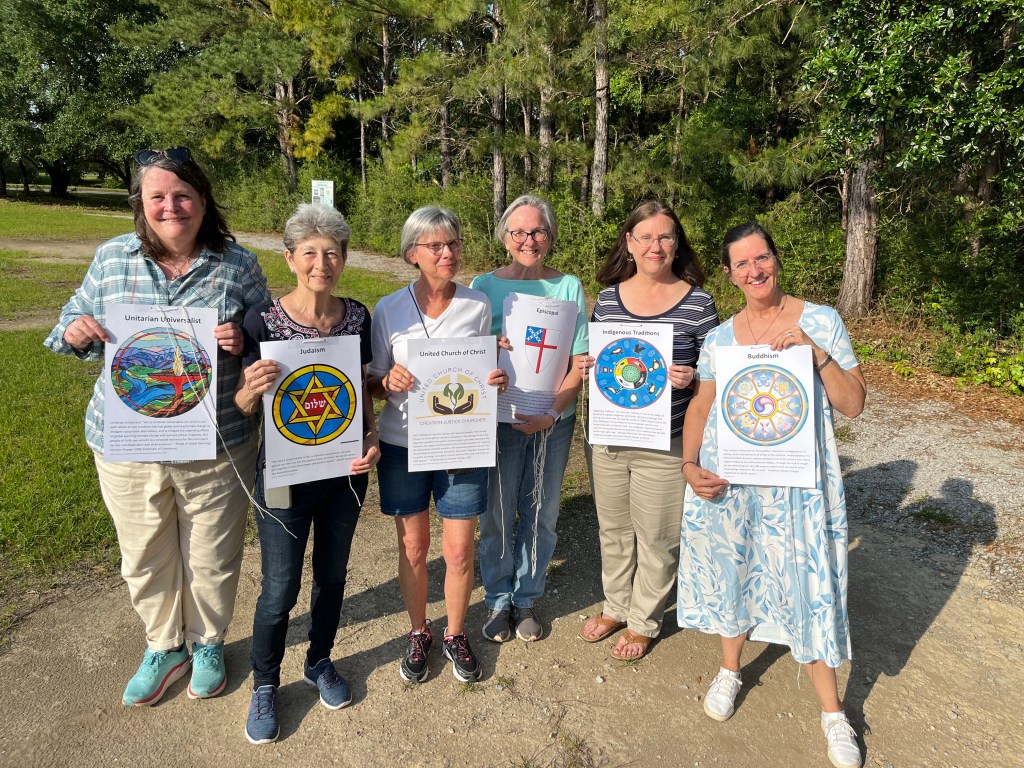
More locally, Mobile-based Gulf Coast Creation Care is a collection of Episcopal, Presbyterian, Unitarian and United Church of Christ congregations that have committed to taking action to fight climate change.
“There aren’t a lot of us, to be honest,” said Rhoda Vanderhart, who is one of the founders of Gulf Coast Creation Care. She described her church, Open Table United Church of Christ, as an “anomaly” in the Mobile area.
Though she grew up in a highly conservative and biblically literal denomination of Christianity, Vanderhart said she now considers scientists to be “the world’s best theologians” by trying to understand creation through their research.
“I consider myself a person of deep faith, probably more so than when I was a child,” she said. “… Faith is knowing that I don’t know and being OK with that.”
Presbyterian Church (USA) congregations often have environmental goals, Thagard said, like litter cleanups or installing solar panels on church buildings. This year’s Presbyterian Women’s Bible study is focused on the subjects of environmental justice and climate change.
Environmental stewardship is also a core part of the work at Living River Retreat, which hosts faith-based retreats and summer camps as well as both religious and secular events. Thagard said the retreat’s 440 acres on the Cahaba River are incredibly biodiverse.
“We feel a great responsibility in keeping it the way it’s supposed to be,” she said.
Living River has hosted mussel researchers from the University of Alabama and the Urban Turtle Project to conduct studies in and around the river, Thagard said. They also added solar panels to the retreat’s dining hall and removed a concrete road crossing the river, she said, to allow upstream migration for mussels and fish.
“We do feel like it is a spiritual thing to care for the creation that we were given and try to repair the damage that we’ve done to it,” she said. The retreat property was formerly a coal mine site, she said.
Summer camps include education about the environment and clean-up trips, Thagard said, alongside their faith-based and recreational activities.
Mathews said she hears from many families who are excited to have a place where those facets of life are integrated, not separated.
“Even in a conservative state like Alabama, there are a lot of families and communities that are desiring a space where they can learn about all aspects of life,” she said.
NATIONAL MISTRUST
While Reeves focuses his research specifically on religious roots of scientific mistrust, there is also a broader trend in the United States of people becoming less trusting of others — and more certain of their own opinions.
Regardless of affiliation, Americans in general are less likely to say they trust scientists or believe that science has had a mostly positive effect on society, according to 2023 research from Pew. Levels of trust have been declining since the beginning of the COVID-19 pandemic, though scientists still have greater public confidence than political, business, religious or media leaders.
“At the root of divisiveness, there is a lack of trust in people who might think differently than yourself and a lack of trust in systems,” said Mathews, who said the pandemic heightened existing problems of mistrust.
“There’s no doubt, Covid is a symptom to me of a larger problem,” Reeves said.
Vanderhart said Covid is just one of many sources of disruption in recent years. Economic uncertainty, political discord and climate disasters have regularly put daily life into upheaval, she said.
“I think people in general are feeling like the rug of stability is being pulled out from under them, and they’re desperate for certainty,” she said
In the midst of that uncertainty, people tend to cling to beliefs that feel safe and will close themselves off from information that undermines that perceived safety, Vanderhart said. For some, a theology that claims to have all the answers can provide the stability they lack, she said.
“Science is uncertainty combined with curiosity, that’s what it is. And it’s discovery and not knowing and wanting to find out. And someone who’s coming from this place of fear is not going to be about not knowing,” Vanderhart said. “… That’s not faith. That’s putting blinders on and trying to feel safe.”
“It does feel like really high stakes for people who are engaged in environmental work.”
Rev. Rachel VanKirk Mathews, Living River Retreat
The isolating effects of social media also cause people to block out information outside their own bubbles, whether intentionally or not, Reeves said. Samford is a Christian university, and Reeves said many of his students now have less interaction with opposing views than they did in the past.
“Because we have a very polarized country, often the students who come to Samford who are skeptical of science are often taught that this is just the way it is,” Reeves said. Before he can encourage those students to expand their information bubbles, Reeves said he often has to start by teaching them why this isolation of viewpoints is even a problem.
Public opinion on topics like climate change also seem to be more or less “locked in.” The Reuters Institute released research findings in January showing that people’s views on climate risks and policy have remained pretty much stable over the last three years.
Yale’s 2023 Climate Opinion Map showed that about 62% of Alabamians believe global warming is happening, but only around half are worried about it or think citizens or officials should be doing more about climate change. Alabama slightly trails the U.S. average in all of these beliefs.
‘AND IT WAS GOOD’
This hardening of people’s worldviews spells trouble for effectively responding to a global crisis like climate change, which experts agree will require massive and unified efforts from governments, corporations and citizens alike.
Each person who can’t be convinced to trust the scientific consensus around climate change and act on it is one less person who can help make those efforts.
“It does feel like really high stakes for people who are engaged in environmental work,” Mathews said.

Among Americans who said religion was one of the most important things in their lives, the PRRI survey found fewer than 20% believed climate change is a crisis. Meanwhile, Pew found that about 11% of people said climate change wasn’t a serious concern because “God is in control of the climate.”
“If we don’t figure this out, our children and grandchildren and great-grandchildren are going to pay for it,” Thagard said. “… Those words [in Genesis] were ‘And it was good,’ and now we can’t always say that.”
Scientists who study climate change agree that the next few years are a rapidly vanishing window for trying to stop the worst effects of climate change.
“We know now that they’ve been conservative in the last 50 years in their prognostications about climate change,” Vanderhart said. “… It’s all happening faster than they said it would.”
WHAT TO DO ABOUT TRUST
The present moment is highly polarized, but Reeves said mistrust is as old as human society itself. Ancient texts like the Bible, the Torah and the Quran all include verses about being wary of false teachings and deceptive people.
“I will say all societies have dealt with issues of who to trust and misinformation, and how people use information to achieve their political ends,” he said.
From his perspective, establishing a strong relationship and engaging honestly with people’s skepticism is one of the best ways to improve trust. Reeves has seen this at work in his own classroom, where students “actually appreciate the opportunity to be exposed to multiple points of view” when he tries to present them fairly.
“You really need a long time to develop a relationship and present evidence,” he said. “… [I’m] not saying you have to agree with me, but you have to wrestle with multiple viewpoints and come down on your own opinion.”
Mathews said she tries to challenge herself to build relationships with people whose faith and worldview are different from her own.
“I think Jesus was all about building relationships across differences,” she said.
Clergy leaders can be models for their congregations of curiosity and “a way of thinking of the world that isn’t closed down or scared of elites,” Reeves said, as a way to encourage learning and increase trust.
As a pastor, Mathews also said she holds a responsibility to expose her congregation to different sources of knowledge.
“I would hope that clergy of all traditions see that as a responsibility because our diversity reflects God’s image,” she said. “… Sometimes that lack of trust is for good reason, so I think clergy also need to provide space for congregation members to share with each other their stories and why there might be distrust or pain.”
Vanderhart agreed: “Clergy has more of a role than ever. … I think that the time has come where they need to [speak up]. It’s important because of the disinformation we have and the way that we all consume our news now.”
Thagard also said that faith leaders can work to open people’s eyes to the realities of topics like climate change and environmental justice, but those things have to be important to the congregation itself for real changes in behavior to occur.
“The leaders can influence, but it’s so much more effective when it comes from the ground up, from the pews to the pulpit,” Thagard said.
Mathews said talking honestly about science, even when that includes imperfections and uncertainties, can increase trust, not diminish it. She said faith and skepticism aren’t always black-and-white issues.
“Sometimes, for some reason, we might shame one another for not being on board with a stance, … but there is always nuance,” she said.
People who trust in both faith and science can be a key bridge for fellow believers to build that same trust, Reeves said.
“The right message when you don’t trust the messenger isn’t going to have any effect,” he said.
Main article image courtesy of Living River Retreat.
 Southern Science