
by Sydney Cromwell
A project to reconnect 230 miles of the Alabama River for migratory aquatic species may be “one of, if not the most important ecosystem restoration projects in the United States,” according to Mitchell Reid, the Alabama state director for The Nature Conservancy.
But right now, the fish passage project is navigating some roadblocks of its own, as the U.S. Army Corps of Engineers and The Nature Conservancy try to create a partnership that works for both organizations. It’s likely going to take congressional intervention for these fish passages to find a way forward.
The Claiborne and Millers Ferry dams have blocked fish from navigating up the Alabama River for decades. Building passages around the dams that mimic natural water movement would reconnect the Alabama and Cahaba rivers for a dozen or so species of fish, mussels and other river life, several of which are endangered.
“That would allow them to restore their migratory runs up to the Cahaba River,” Reid said.
Read more from Southern Science about how dams affect river ecosystems and endangered species.
The Corps of Engineers and TNC started studying options to remove these migratory roadblocks in 2021. In 2023, the Corps of Engineers presented its proposed plans to the public, which was followed by more review from the state and relevant agencies in 2024.
The bypass channels would include rock weirs and soil to mimic natural pools that fish could swim through as they traveled up the slope to the upstream side of each dam. At Millers Ferry, the channel would also include control gates and vehicle bridges.
Each passage would be on the western bank of the river. The Claiborne channel would be about 80 feet long, while the steeper elevation at Millers Ferry means the channel would be around 200 feet long.
Since the dams would remain in place, the fish passages would not affect boat navigation or Millers Ferry’s hydropower generation. A private company has also begun the application process to create a hydroelectric plant at Claiborne Dam. Both TNC and the Alabama Rivers Alliance are opposing the project for its environmental impact.
The Corps of Engineers estimates that it would take six years from project authorization to complete construction on the passages at both dams.
The two projects were estimated to cost around $222 million in a 2024 report, which Reid described as a “pretty darn good deal.”
“It’s just bonkers how many fish and other organisms are going to benefit from this,” Reid said.
For a project like the Claiborne and Millers Ferry fish passages, the Corps of Engineers requires a non-federal sponsor that takes on the liability and ongoing operations.
The Nature Conservancy has been a partner for this project so far, Reid said, and the nonprofit is contributing 35% of the construction costs.
The hangup, however, is “an issue that was always sort of in the wings” as the two organizations studied their fish passage options, Reid said. It is “just not tenable,” he said, for a nonprofit like TNC to take on liability and operation costs for a dam like Millers Ferry that is still generating hydropower.
“We can’t sign on to maintain a federal structure,” Reid said. “… You can’t restore ecosystems on the backs of nonprofit organizations. That’s really not a sustainable path forward.”
It’s more feasible for the nonfederal sponsor to take on that liability in Corps projects where the sponsor eventually profits financially, Reid said. In this case, however, the benefit can’t be measured in dollar signs.
“The benefits are benefits to society. How do you put the cost on any one organization for preserving, say, the elephant ear mussel?” he said. “… The public good is worth the public investment.”
Since The Nature Conservancy can’t agree to “business as usual,” as Reid put it, the fish passage project has stalled out. The study was terminated by the Corps before the Chief’s Report was signed, due to the lack of a non-federal sponsor, according to Heather Bulger, chief of the Inland Environment Team for the Corps of Engineers’ Mobile District. The Chief’s Report is required for any project that needs congressional authorization.
“This is not done with animosity. We’re not fighting each other. Both organizations are legitimately trying to find a path forward,” Reid said.
The project wasn’t included in the 2024 Water Resources Development Act, which is the recurring bill that authorizes projects of this sort across the country. The next chance to be funded through WRDA will be in 2026.
Reid said the logjam is going to require a legislative solution.
“It’s going to take political will to say, ‘We want to do the right thing for this [river] system,’” Reid said.
TNC is planning to work with the Corps and the state’s congressional representatives, he said, to write legislation that either lets the Corps take on all the liability for the project or changes the terms of TNC’s sponsorship.
“This has the potential to change the paradigm of the way the Corps does this,” Reid said.
After the two organizations have a workable agreement in place, the fish passage project can then be authorized and funded by Congress.
“Once those things are lined up, the Corps is really good about saluting and executing and getting stuff done,” Reid said.
But he’s constantly aware of the time passing and the fish and mussel species that are slowly declining without a passage upriver.
“We’ve said all along, this is an ecosystem on the brink,” Reid said. “… We can’t dilly dally. We’ve got to just keep moving forward.”
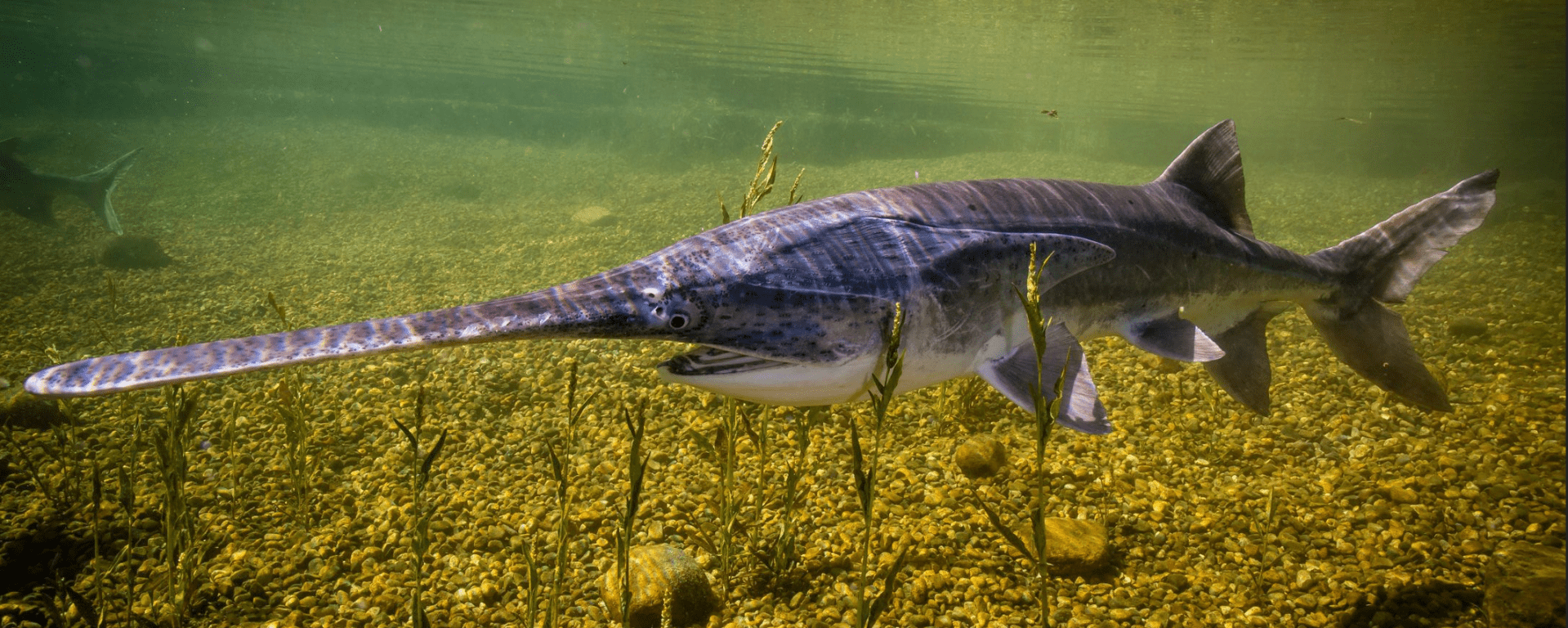
Main article image of a paddlefish courtesy of the U.S. Fish and Wildlife Service.
 Southern Science